Micro Introduction
The word cautious is common in daily conversation, academic writing, and professional communication. It describes someone who avoids risks and thinks carefully before acting.
Learning synonyms for cautious helps you express ideas more clearly and avoid repeating the same word in writing or speech.
Direct Answer
Meaning of Cautious
Cautious means being careful and thinking about possible risks before acting.
People who are cautious try to avoid mistakes, danger, or problems.
Common Synonyms for Cautious
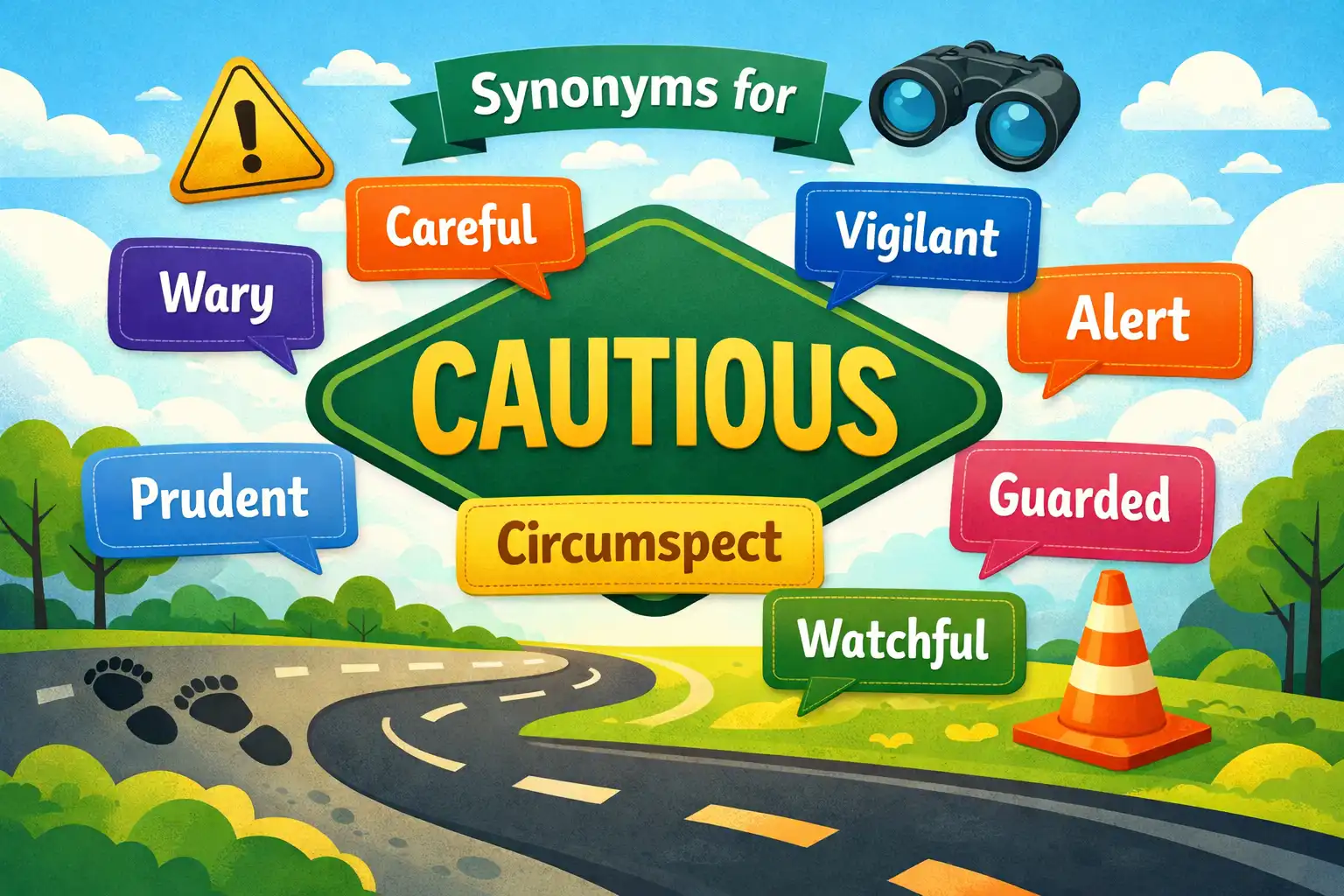
- careful
- wary
- vigilant
- prudent
- alert
- guarded
Categories of Synonyms
Different synonyms for cautious emphasize slightly different ideas. Understanding these categories helps you choose the right word.
Careful Thinking
These words describe people who think deeply before making decisions.
Examples include words that highlight planning and thoughtful behavior.
Safety Awareness
These synonyms focus on being aware of danger or problems.
They often describe people who watch their surroundings carefully.
Risk Avoidance
These words describe people who avoid unnecessary risks.
They are often used in business, finance, or serious decision-making contexts.
Synonyms Table
| Word | Simple Meaning | Example Sentence |
| careful | paying attention to avoid mistakes | She was careful while crossing the busy road. |
| wary | not fully trusting something | He felt wary about sharing personal information online. |
| vigilant | watching carefully for danger | Security guards remained vigilant throughout the night. |
| prudent | making wise and sensible choices | Saving money regularly is a prudent decision. |
| alert | quick to notice problems | Drivers must stay alert during long trips. |
| guarded | careful about sharing thoughts or feelings | She gave a guarded response to the reporter’s question. |
Master Synonyms List (Grouped by Level)
Beginner / Simple Synonyms
Mindful
Simple meaning: paying attention to actions and surroundings
Example: He was mindful of the slippery floor while walking.
Watchful
Simple meaning: carefully observing for danger
Example: The teacher stayed watchful during the school trip.
Deliberate
Simple meaning: done slowly and with careful thought
Example: She made a deliberate choice to review the contract again.
Intermediate Synonyms
Circumspect
Simple meaning: thinking carefully before speaking or acting
Example: The manager remained circumspect when discussing company plans.
Discreet
Simple meaning: careful not to reveal private information
Example: The lawyer gave a discreet reply during the interview.
Conservative
Simple meaning: avoiding unnecessary risks
Example: Investors took a conservative approach to the market.
Advanced / Formal Synonyms
Chary (Formal)
Simple meaning: cautious about trusting or accepting something
Example: She was chary of signing the agreement without legal advice.
Formal vs Informal Synonyms
Some synonyms for cautious work better in casual conversation, while others are more suitable for formal writing.
Informal or everyday words
- careful
- mindful
- watchful
- alert
These are common in daily conversation and simple writing.
Example:
“Be careful while driving.”
Formal or academic words
- prudent
- circumspect
- discreet
- chary
These appear more often in professional writing, academic essays, or reports.
Example:
“The committee adopted a prudent financial strategy.”
Choosing the correct tone improves clarity and professionalism.
Real-Life Usage Examples
Conversation
“I’m a bit careful when meeting new people online.”
Academic Writing
“The researcher remained circumspect when interpreting the early results.”
Business Writing
“The company adopted a conservative investment strategy.”
Blogging
“Travelers should stay alert when exploring unfamiliar places.”
Emotional Expression
“She was wary after her previous negative experience.”
Similar Words Comparison
Cautious vs Careful
Both words describe avoiding mistakes or danger.
Cautious emphasizes thinking before acting.
Careful emphasizes paying attention during an action.
Example:
- She was cautious before signing the contract.
- He was careful while handling the fragile glass.
Cautious vs Prudent
Both involve wise decision-making.
Cautious focuses on avoiding risk.
Prudent focuses on making smart, responsible choices.
Example:
- Investors remained cautious during the market downturn.
- Saving for emergencies is a prudent habit.
Example Sentences
- She remained cautious about sharing personal details online.
- Drivers should be alert during heavy rain.
- The company made a prudent financial decision.
- He gave a guarded answer to the reporter.
- Investors stayed wary of risky opportunities.
- Teachers must remain watchful during school trips.
- She was mindful of her responsibilities at work.
- The police officers stayed vigilant during the event.
- His deliberate approach helped prevent mistakes.
- Lawyers must be discreet with client information.
- The analyst gave a circumspect opinion on the issue.
- The board took a conservative approach to expansion.
- She remained chary of trusting unfamiliar websites.
- Being careful can prevent many everyday accidents.
- The traveler stayed alert in crowded areas.
Common Mistakes
1. Using Formal Words in Casual Conversation
Words like circumspect or chary may sound unnatural in everyday speech.
Instead say:
“Be careful.”
2. Confusing Cautious With Fearful
Being cautious does not mean being afraid.
Example:
A cautious person evaluates risks but still takes action.
3. Overusing One Synonym
Repeating the same word can make writing boring.
Instead of repeating careful, vary your vocabulary.
4. Using Synonyms Without Context
Not all synonyms fit every situation.
Example:
Discreet relates to privacy, not physical danger.
Tips for Choosing the Right Synonym
Consider these factors before choosing a synonym:
Tone
Formal writing may require words like prudent or circumspect.
Context
Use words related to the situation.
For safety situations, words like alert or vigilant work well.
Formality
Casual speech works better with simple words like careful.
Clarity
Choose the word that readers easily understand.
Also avoid overusing any synonym. Repeating the same word too often can weaken your writing.
When NOT to Use “Cautious”
Sometimes cautious may not be the best word.
Avoid using it when:
- The person is simply paying attention during an action
- The situation requires describing fear or anxiety
- The context involves privacy rather than safety
For example:
Incorrect:
“She was cautious with private information.”
Better:
“She was discreet with private information.”
Opposite Words (Antonyms)
Common antonyms of cautious include:
- reckless
- careless
- impulsive
- rash
- irresponsible
These words describe people who act without considering risks.
Example:
“His reckless decision caused serious problems.”
FAQs
What does cautious mean?
Cautious means being careful and thinking about risks before acting.
Is cautious formal or informal?
The word cautious works in both formal and informal situations.
How can I use cautious in conversation?
You can say:
“I’m cautious about sharing personal data online.”
What is the best synonym for cautious?
Common alternatives include careful, wary, and prudent.
Can cautious be replaced with careful?
Yes, in many situations careful works as a simple synonym.
Is cautious always negative?
No. It often has a positive meaning because it shows responsibility and awareness.
What is a formal synonym for cautious?
Formal options include prudent, circumspect, and chary.
What is a simple synonym for cautious?
The simplest synonym is careful.
Can cautious describe decision making?
Yes. It often describes thoughtful decision-making.
Example:
“She took a cautious approach to the investment.”
Is cautious related to fear?
Not necessarily. It means being careful, not being afraid.
Conclusion
Learning synonyms for cautious improves both writing and speaking. Instead of repeating the same word, you can choose alternatives that match the situation, tone, and level of formality.
Using the right synonym makes communication clearer and more professional.
Try using three new synonyms from this list in your next sentence to strengthen your vocabulary.

Andrew Powell is a research-focused editorial writer specializing in word meanings, semantic distinctions, and language accuracy. With a professional background in research-based informational writing, he has built his work around careful analysis of how words function in context and how subtle variations in meaning influence communication.
Andrew’s expertise lies in word comparison and semantic precision. His work examines closely related terms, clarifies usage differences, and explains how context shapes interpretation. Rather than offering surface-level definitions, he approaches language with a structured methodology—reviewing usage patterns, consulting authoritative dictionaries, analyzing corpus data, and evaluating real-world examples. This research-driven process ensures that readers receive clear, reliable explanations grounded in linguistic evidence.
A core focus of his writing is helping readers understand meaning differences that are often overlooked. Whether distinguishing between near-synonyms, exploring formal versus informal usage, or clarifying nuanced grammatical structures, Andrew aims to remove ambiguity. His explanations are designed to support students, writers, educators, and professionals who rely on precise language in academic, business, or creative contexts.
Andrew contributes to the Word Synonyms niche with an emphasis on clarity, neutrality, and factual accuracy. He prioritizes language accuracy over simplification and avoids unsupported claims. Each piece is structured to answer specific user queries while maintaining contextual depth, aligning with current search quality standards and semantic SEO principles.
By combining research-based writing with careful editorial standards, Andrew Powell helps readers develop stronger vocabulary awareness and make informed word choices. His work reflects a commitment to trustworthy information, thoughtful analysis, and practical value for anyone seeking a deeper understanding of English semantics.