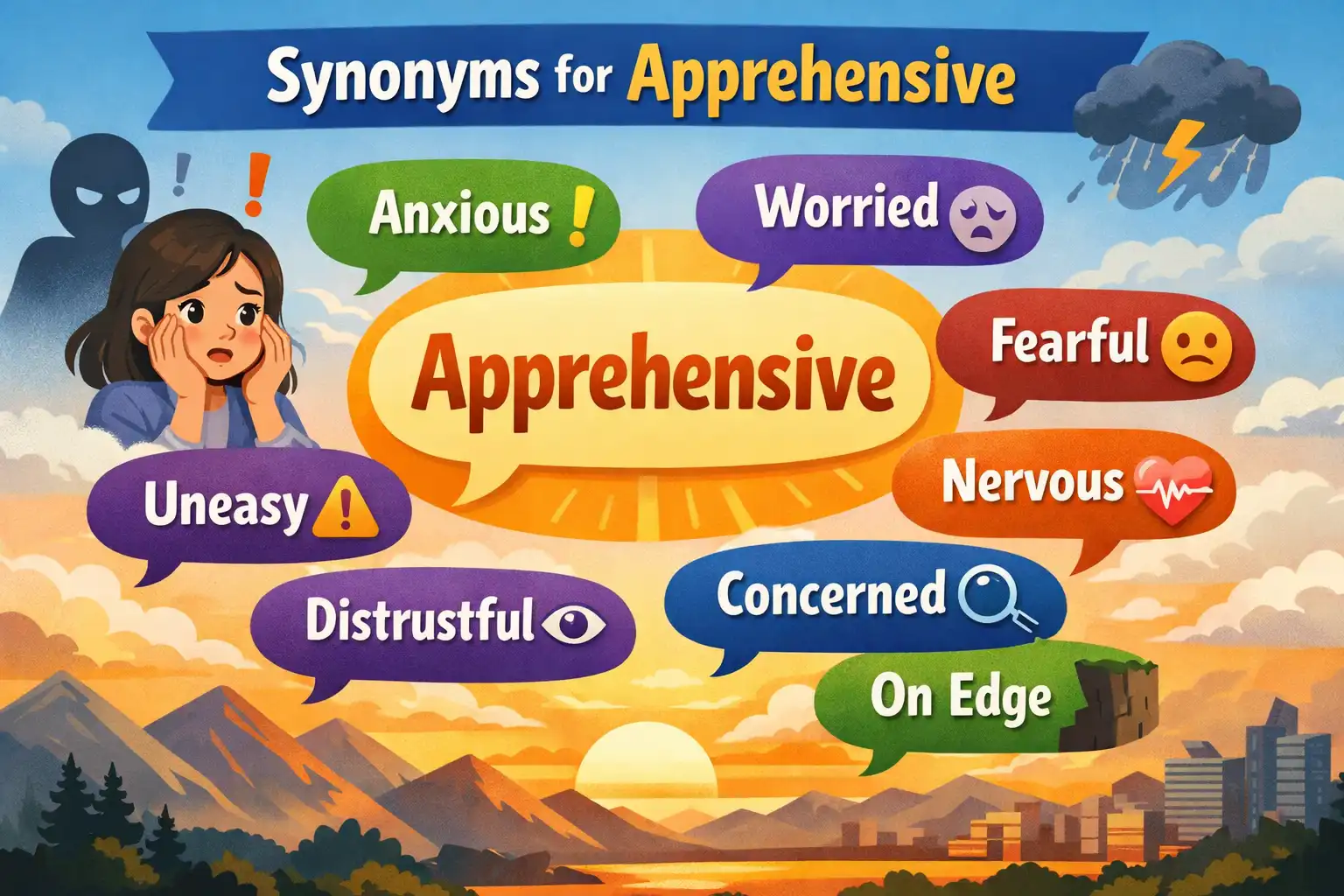
Common synonyms for ‘apprehensive’ include:
- Anxious
- Nervous
- Worried
- Uneasy
- Concerned
- Fearful
- Alarmed
- Jittery
Meaning of Apprehensive
‘Apprehensive’ describes a feeling of unease or anxiety about something that may happen in the future. It often indicates a sense of nervousness or worry, typically about an upcoming event or situation.
- Example 1: She felt apprehensive about starting her new job.
- Example 2: His apprehensive expression made it clear he was unsure about the decision.
Synonyms Table
| Word | Meaning | Example |
| Anxious | Feeling nervous or worried, especially about the future | She was anxious before the big exam. |
| Nervous | Experiencing fear or anxiety about something uncertain | The nervous child clung to her mother. |
| Worried | Concerned or troubled about something | I’m worried about the weather tomorrow. |
| Uneasy | Feeling discomfort or nervousness about something | He felt uneasy about the meeting. |
| Concerned | Feeling troubled or uneasy about a situation | I’m concerned about the lack of communication. |
| Fearful | Feeling afraid or apprehensive, especially about danger | The fearful child avoided the dark room. |
| Alarmed | Shocked or frightened by something sudden or unexpected | She was alarmed by the loud noise outside. |
| Jittery | Feeling nervous or on edge, often with physical signs | He felt jittery before his first public speaking event. |
| Distrustful | Lacking trust or confidence, feeling apprehensive about others | His distrustful attitude made the team uneasy. |
| Hesitant | Reluctant to act due to uncertainty or fear | She was hesitant to accept the job offer. |
| Tense | Feeling tightness or nervous energy in the body | The tense atmosphere in the room made everyone quiet. |
| Restless | Unable to relax, often due to worry or discomfort | He grew restless as the meeting dragged on. |
| Worried sick | Extremely concerned or anxious about something | I was worried sick when my daughter didn’t come home on time. |
Formal and Informal Synonyms
Formal Synonyms:
- Anxious
- Concerned
- Fearful
These synonyms are often used in formal writing, such as professional emails, reports, or academic papers. They convey a sense of serious or legitimate worry.
Informal Synonyms:
- Nervous
- Uneasy
- Jittery
These are more commonly used in casual conversation, as they are less formal and often express mild to moderate levels of anxiety.
Context Usage Section
Conversations:
In casual conversations, synonyms for ‘apprehensive’ help to describe nervousness or worry. People often use words like “nervous” or “uneasy” to discuss minor concerns. For example, “I’m a little nervous about the presentation tomorrow.”
Writing:
In formal writing, terms like “anxious” or “concerned” are more suitable as they communicate a deeper or more considered level of worry. “She was concerned about the implications of the decision.”
Emotional Expression:
Synonyms for ‘apprehensive’ often reflect emotions such as fear, uncertainty, or discomfort. For example, “I was jittery before the big test” communicates a mild but noticeable anxiety, while “He was fearful of the upcoming surgery” conveys a more intense emotional state.
Comparison Section
Apprehensive vs. Anxious
Both “apprehensive” and “anxious” describe feelings of unease about something in the future, but “anxious” can imply a more intense or long-lasting state.
- Example: “She was apprehensive about the test, but her anxious thoughts lasted for days.”
- “Apprehensive” is more common when talking about immediate, mild unease, whereas “anxious” can denote a persistent feeling that may impact overall well-being.
Apprehensive vs. Nervous
“Nervous” is often used in less serious contexts than “apprehensive,” implying a milder or more temporary state of worry.
- Example: “He was nervous about the interview but felt more at ease once he started.”
- “Apprehensive” may suggest a deeper, more ongoing concern, whereas “nervous” can refer to a temporary reaction to an event.
Example Sentences
- She felt anxious before her first day at the new job.
- The little boy looked nervous as the doctor approached.
- I was worried about my performance on the final exam.
- He was uneasy about the upcoming trip, not knowing what to expect.
- She seemed concerned when she heard about the storm.
- The fearful child refused to go into the dark room.
- I was alarmed by the sudden change in his behavior.
- He felt jittery before his big presentation.
- She felt distrustful of his promises, having been let down before.
- He was hesitant to make the decision without more information.
- The atmosphere in the office was tense after the announcement.
- He was restless during the long wait in the airport.
- She was worried sick about her missing cat.
- I felt uneasy when I heard strange noises in the house.
- They looked anxious as the flight was delayed.
Common Mistakes
- Confusing “apprehensive” with “fearful”:
“Apprehensive” can be mild, while “fearful” is often used to describe a more intense emotion. Choosing “fearful” for situations that are only mildly concerning can be an exaggeration. - Using “nervous” for serious situations:
While “nervous” can describe temporary unease, it’s inappropriate for situations requiring more formal language or describing long-term concerns, such as in academic or professional contexts. “Anxious” or “concerned” would be more suitable. - Overusing “worried” in formal writing:
“Worried” is a casual synonym. In formal writing, consider using “concerned” or “anxious” instead, which are more professional and convey a deeper level of unease.
FAQ
1. What is the difference between “apprehensive” and “anxious”?
“Apprehensive” refers to mild unease, while “anxious” suggests a more intense or prolonged state of worry.
2. Can “uneasy” and “nervous” be used interchangeably?
Yes, both can describe feelings of discomfort or worry, but “uneasy” is often used in more serious or uncertain situations, whereas “nervous” tends to describe temporary reactions.
3. Which synonym is most suitable for formal writing?
For formal writing, “anxious” and “concerned” are more appropriate, as they convey a sense of seriousness and thoughtfulness.
Conclusion
The word “apprehensive” captures the feeling of worry or unease about the future. Its synonyms, including “anxious,” “nervous,” and “concerned,” offer subtle differences in intensity and formality. Understanding when to use these synonyms in different contexts—whether casual or formal—helps ensure clarity in communication.

Andrew Powell is a research-focused editorial writer specializing in word meanings, semantic distinctions, and language accuracy. With a professional background in research-based informational writing, he has built his work around careful analysis of how words function in context and how subtle variations in meaning influence communication.
Andrew’s expertise lies in word comparison and semantic precision. His work examines closely related terms, clarifies usage differences, and explains how context shapes interpretation. Rather than offering surface-level definitions, he approaches language with a structured methodology—reviewing usage patterns, consulting authoritative dictionaries, analyzing corpus data, and evaluating real-world examples. This research-driven process ensures that readers receive clear, reliable explanations grounded in linguistic evidence.
A core focus of his writing is helping readers understand meaning differences that are often overlooked. Whether distinguishing between near-synonyms, exploring formal versus informal usage, or clarifying nuanced grammatical structures, Andrew aims to remove ambiguity. His explanations are designed to support students, writers, educators, and professionals who rely on precise language in academic, business, or creative contexts.
Andrew contributes to the Word Synonyms niche with an emphasis on clarity, neutrality, and factual accuracy. He prioritizes language accuracy over simplification and avoids unsupported claims. Each piece is structured to answer specific user queries while maintaining contextual depth, aligning with current search quality standards and semantic SEO principles.
By combining research-based writing with careful editorial standards, Andrew Powell helps readers develop stronger vocabulary awareness and make informed word choices. His work reflects a commitment to trustworthy information, thoughtful analysis, and practical value for anyone seeking a deeper understanding of English semantics.