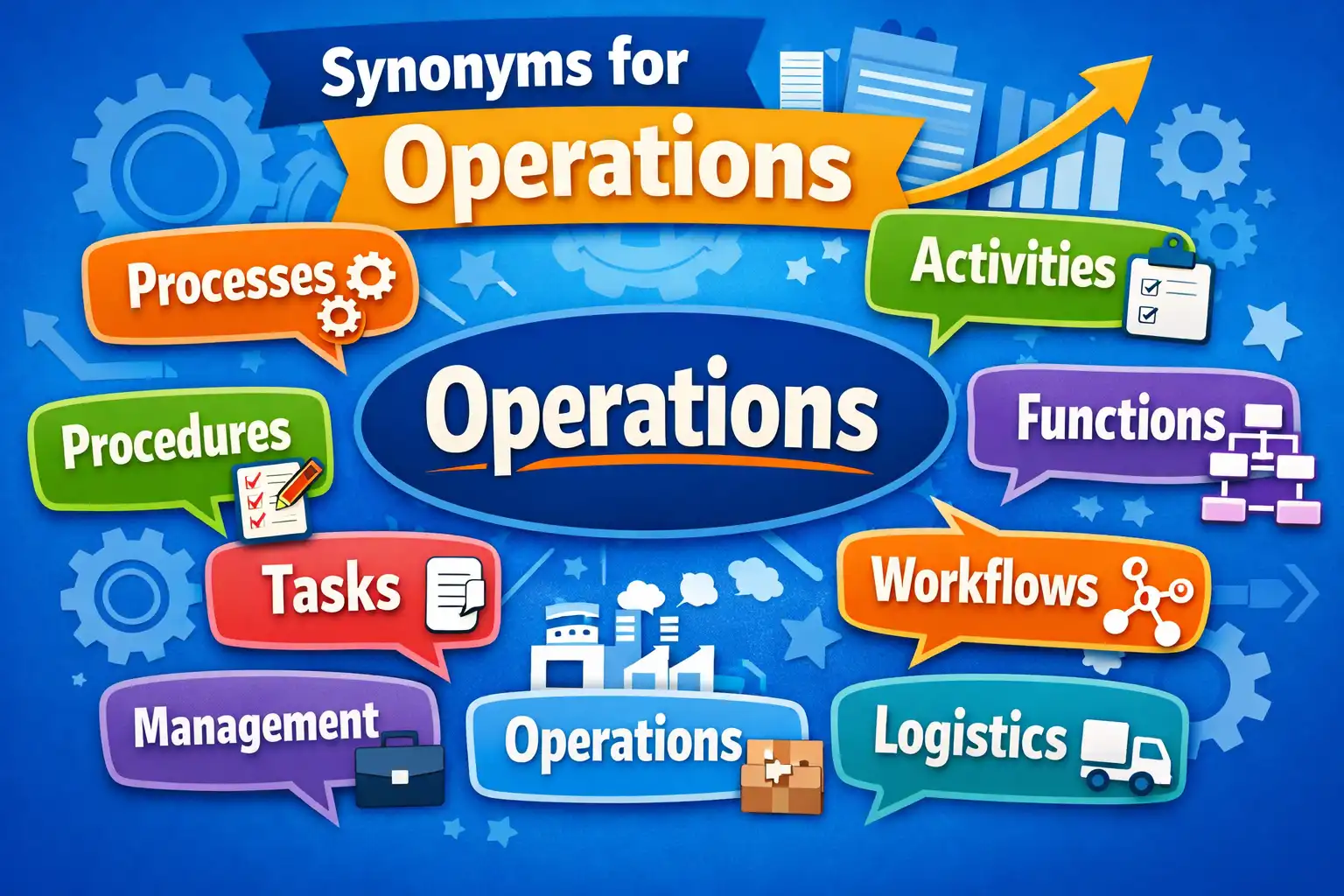
The word operations is widely used in business, healthcare, education, and everyday English.
It usually describes how work is run, how systems function, or how organized activities happen over time.
If you keep repeating the word operations in writing or speech, learning the right synonyms for each context helps you sound clearer, more natural, and more professional.
Direct Answer: What Does Operations Mean?
Operations means the ongoing activities, processes, or systems used to run work, organizations, or services.
It is commonly used for:
- business operations
- medical operations
- military operations
- daily work systems
Meaning of Operations (Simple Explanation)
Operations refers to how work is planned, managed, and carried out on a regular basis.
It does not mean one small action.
It usually means the entire system or workflow that keeps things running.
Example:
The company improved its shipping operations to deliver orders faster.
Synonyms for Operations by Context
Different situations need different words. Below are context-based alternatives instead of one-size-fits-all synonyms.
1. Physical Work (Operations on the Ground)
Used when work is actively done.
Best synonyms:
- activities
- work
- actions
- duties
Example:
Daily warehouse activities start early in the morning.
2. Systems & Workflows
Used when work follows structured steps.
Best synonyms:
- processes
- procedures
- workflows
- routines
Example:
Hiring processes take longer in large organizations.
3. Business Operations (Professional Writing)
Used in formal, office, or corporate writing.
Best synonyms:
- business functions
- operational activities
- execution
- organizational processes
Example:
Customer support operations improved after staff training.
Synonyms for Operations (Quick Comparison Table)
| Word | Best Used When | Example |
| activities | general daily work | Daily activities begin at 9 a.m. |
| tasks | small pieces of work | She completed all tasks on time. |
| processes | step-by-step systems | Billing is an automated process. |
| procedures | official rules or steps | Safety procedures must be followed. |
| functions | roles or responsibilities | HR functions include hiring. |
| workflows | connected work steps | The workflow was redesigned. |
Synonyms by Skill Level
Beginner / Everyday English
- activities → daily work people do
- tasks → small jobs
Intermediate / Workplace English
- processes → organized steps
- routines → repeated work patterns
Advanced / Formal Writing
- procedures → official methods
- execution → carrying out plans (formal tone)
⚠️ Tip: Avoid execution in casual conversation — it sounds too formal.
Formal vs Informal Usage
- Casual / conversation:
tasks, activities, work - Professional / academic:
operations, processes, procedures
Rule:
If the work is ongoing and system-based, operations fits best.
Real-Life Usage Examples
- Conversation: Our daily operations run smoothly now.
- Business: Sales operations expanded this quarter.
- Healthcare: Hospital operations follow strict protocols.
- Education: University operations moved online.
- Logistics: Warehouse operations run 24/7.
Operations vs Similar Words
Operations vs Processes
- Operations = the full system
- Processes = individual step-by-step methods
Example:
Operations improved after the billing process was fixed.
Operations vs Tasks
- Operations = big picture
- Tasks = small actions inside that system
Example:
Daily operations include dozens of small tasks.
Example Sentences Using Operations
- Business operations depend on teamwork.
- Factory operations stopped for maintenance.
- Smooth operations save time and money.
- International operations face legal challenges.
- Hospital operations follow safety standards.
- Online operations run all day.
- Retail operations peak on weekends.
- Military operations were carefully planned.
- Company operations improved after automation.
- Operations require clear management.
Common Mistakes to Avoid
- Using operations for one small task
- Confusing operations with surgery outside medical context
- Overusing the word instead of simpler alternatives
- Mixing operation (single event) with operations (ongoing system)
Best Practices for Choosing the Right Word
- Use operations for systems, not actions
- Use tasks for small work items
- Use processes for step-based methods
- Match tone: formal vs casual
When NOT to Use Operations
Avoid operations when talking about:
- one simple action
- personal feelings
- casual daily chores
❌ “My operation is to clean my room.”
✅ “My task is to clean my room.”
Antonyms of Operations (With Usage)
Below are common antonyms of operations, with 1–2 clear lines explaining when you would use each one. These are simple, real-world words used by native English speakers.
- Inactivity
Use this when nothing is happening or no work is being done.
Example use: During inactivity, the system saves energy. - Shutdown
Use this when operations are fully stopped, often for machines or businesses.
Example use: The factory faced a temporary shutdown. - Stoppage
Use this for an unexpected or forced stop in work or processes.
Example use: Production halted due to a work stoppage. - Idleness
Use this when people or resources are not being used.
Example use: Idleness in the office reduced productivity. - Suspension
Use this when operations are paused but may restart later.
Example use: Operations were under suspension during repairs. - Closure
Use this when operations end permanently.
Example use: The store announced its closure last year.
Quick Tip
If operations means “work in progress,” its antonyms usually describe no work, paused work, or stopped work.
Always choose the antonym based on whether the stop is temporary or permanent.
FAQs
What does operations mean in business?
It means the systems and activities that keep a company running daily.
Is operations formal English?
It is neutral but mostly used in professional contexts.
Can I replace operations with tasks?
Only when the work is small or simple.
Is operations plural or singular?
It is grammatically plural but often treated as a collective noun.
Conclusion
Operations describes how work runs as a system — not just one action.
Choosing the right synonym based on context makes your writing clearer, more natural, and more professional.
Quick rule:
👉 Big system → operations
👉 Small action → task

Andrew Powell is a research-focused editorial writer specializing in word meanings, semantic distinctions, and language accuracy. With a professional background in research-based informational writing, he has built his work around careful analysis of how words function in context and how subtle variations in meaning influence communication.
Andrew’s expertise lies in word comparison and semantic precision. His work examines closely related terms, clarifies usage differences, and explains how context shapes interpretation. Rather than offering surface-level definitions, he approaches language with a structured methodology—reviewing usage patterns, consulting authoritative dictionaries, analyzing corpus data, and evaluating real-world examples. This research-driven process ensures that readers receive clear, reliable explanations grounded in linguistic evidence.
A core focus of his writing is helping readers understand meaning differences that are often overlooked. Whether distinguishing between near-synonyms, exploring formal versus informal usage, or clarifying nuanced grammatical structures, Andrew aims to remove ambiguity. His explanations are designed to support students, writers, educators, and professionals who rely on precise language in academic, business, or creative contexts.
Andrew contributes to the Word Synonyms niche with an emphasis on clarity, neutrality, and factual accuracy. He prioritizes language accuracy over simplification and avoids unsupported claims. Each piece is structured to answer specific user queries while maintaining contextual depth, aligning with current search quality standards and semantic SEO principles.
By combining research-based writing with careful editorial standards, Andrew Powell helps readers develop stronger vocabulary awareness and make informed word choices. His work reflects a commitment to trustworthy information, thoughtful analysis, and practical value for anyone seeking a deeper understanding of English semantics.