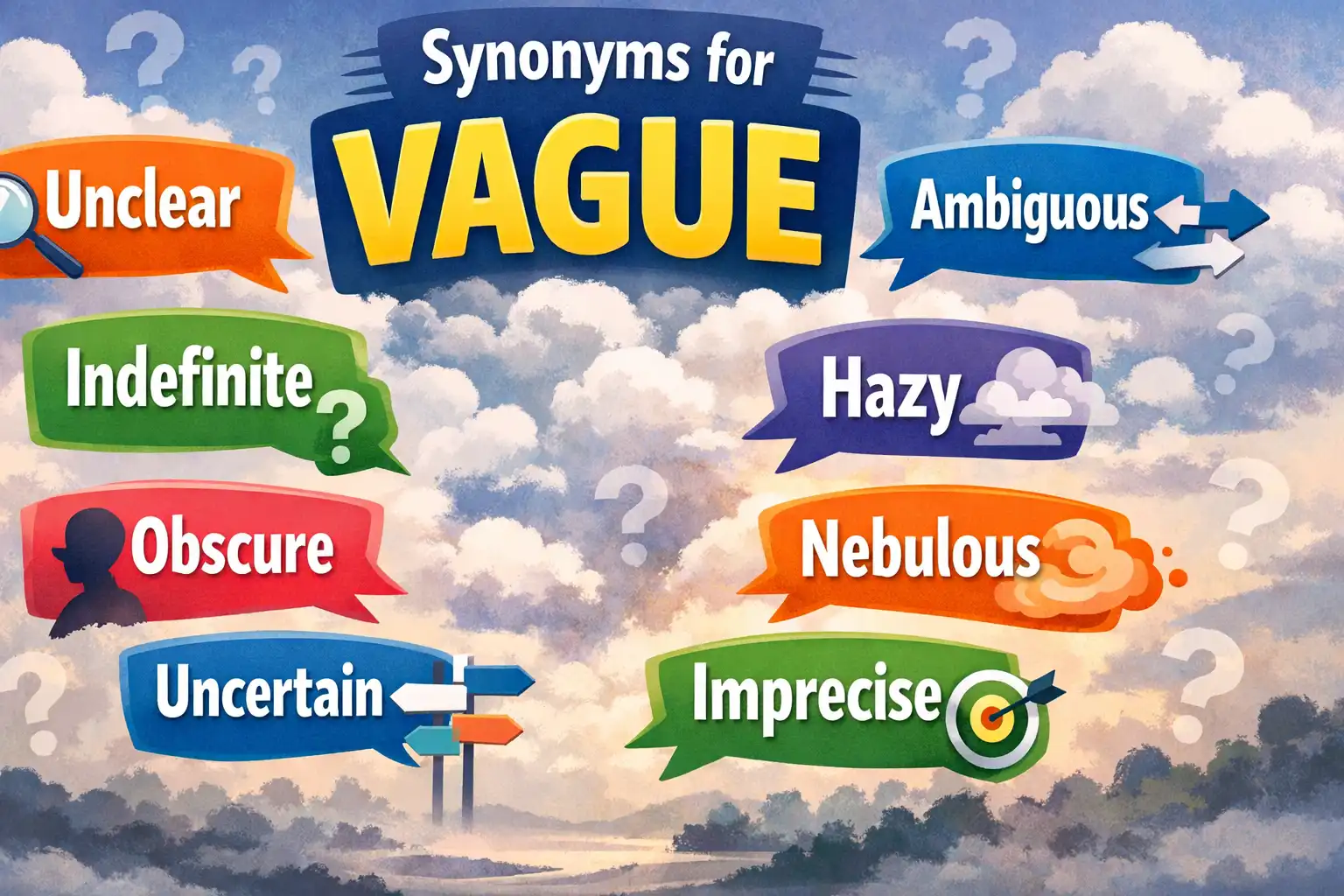
Common synonyms for “vague” include:
- Unclear
- Ambiguous
- Fuzzy
- Indistinct
- Hazy
- Obscure
- Undefined
- General
Meaning of Vague
“Vague” refers to something that is not clearly expressed, defined, or understood. It suggests a lack of clarity or precision in meaning, making it hard to grasp or interpret. This can apply to both ideas and physical objects, often leaving room for confusion or misinterpretation.
Example Sentences:
- Her explanation was so vague that no one understood what she meant.
- The instructions on the box were vague, leaving customers confused.
Synonyms Table
| Word | Meaning | Example |
| Unclear | Not easy to understand or interpret | The instructions were unclear, leading to mistakes. |
| Ambiguous | Open to more than one interpretation | The contract’s terms were ambiguous and caused confusion. |
| Fuzzy | Blurry or not sharply defined | The details were fuzzy, making it hard to make a decision. |
| Indistinct | Not clearly seen, heard, or understood | Her speech was indistinct, and nobody could follow. |
| Hazy | Lacking clarity or precision | The report was hazy, and we couldn’t draw any conclusions. |
| Obscure | Not well-known or understood, difficult to interpret | His motivations remain obscure even after the meeting. |
| Undefined | Not clearly defined or determined | The boundaries of the project were undefined, causing delays. |
| General | Not specific or detailed | The manager gave a general overview of the situation without specifics. |
| Foggy | Unclear or uncertain, especially in thinking | The future of the company is still foggy. |
| Nebulous | Lacking definite form or limits | His plans for the vacation were still nebulous. |
| Ambivalent | Having mixed feelings or contradictory ideas | She had ambivalent thoughts about moving to a new city. |
| Uncertain | Lacking confidence or clarity | The future of the project seems uncertain at this point. |
| Ill-defined | Not clearly marked or outlined | The concept is ill-defined, which makes it hard to discuss. |
| Sketchy | Lacking in detail, incomplete | The proposal was sketchy, with many important facts missing. |
Formal and Informal Synonyms
When choosing synonyms for “vague,” it’s important to consider the context in which you’re writing or speaking. Some synonyms are more suited for formal or academic writing, while others are more appropriate for casual or everyday conversation.
Formal Synonyms:
- Ambiguous
- Obscure
- Undefined
- Indistinct
- Ill-defined
Informal Synonyms:
- Fuzzy
- Hazy
- Sketchy
- Unclear
- General
In formal contexts, you would typically use “ambiguous” or “obscure” to describe something that lacks clarity, while in casual settings, words like “fuzzy” or “sketchy” might be used more frequently.
Context Usage Section
Conversations:
In conversations, people often use synonyms for “vague” to express uncertainty or when something isn’t entirely clear. For example, if someone gives a response that doesn’t provide enough detail, you might say, “That’s a bit fuzzy,” or “Your explanation is vague.”
Writing:
In written work, especially academic or professional writing, you might encounter “ambiguous,” “obscure,” or “undefined” to discuss unclear points. These terms offer a more formal tone than casual synonyms like “fuzzy” or “sketchy.”
Emotional Expression:
Synonyms like “uncertain” or “ambivalent” can be used to express emotional or psychological vagueness. For example, “I feel uncertain about this decision” or “She had ambivalent feelings about moving abroad.”
Comparison Section
Vague vs. Ambiguous
“Vague” and “ambiguous” are often used interchangeably but have subtle differences, “Vague” typically refers to something that lacks clarity or precision, while “ambiguous” implies that something has more than one possible meaning or interpretation.
Example:
- His answer was vague, leaving everyone confused about his stance.
- The wording of the policy was ambiguous, causing multiple interpretations.
Vague vs. Fuzzy
“Fuzzy” often conveys a sense of imprecision or lack of sharpness, particularly when describing unclear information or memory. “Vague” can be used more broadly for unclear concepts, situations, or communication.
Example:
- The report was fuzzy on the details, making it difficult to act.
- She gave a vague response when asked about the future plans.
Example Sentences
- His explanation was so unclear that I had to ask him to repeat it.
- The details in the proposal were ambiguous, which led to misunderstandings.
- The instructions were fuzzy, and I wasn’t sure what to do next.
- The image was so indistinct that I couldn’t tell what it was.
- The future of the project is still hazy.
- The definition of success can often be obscure in modern business.
- The outline was undefined, leaving room for interpretation.
- His viewpoint remained general, offering no specific solutions.
- The roadmap was foggy, and it wasn’t clear where we were headed.
- Her explanation of the concept was still nebulous, making it difficult to understand.
- He had ambivalent feelings about the new project proposal.
- The outcome of the case seemed uncertain as we waited for the verdict.
- The instructions for setting up the device were ill-defined.
- The report was sketchy, missing several crucial facts.
- His response was vague and didn’t address the real issue.
Common Mistakes
- Confusing “vague” with “ambiguous”: “Vague” implies something lacks clarity, whereas “ambiguous” means something has multiple interpretations.
- Using informal synonyms in formal contexts: Words like “fuzzy” and “sketchy” are often too casual for academic or professional writing. Opt for terms like “obscure” or “indistinct” instead.
- Overusing synonyms in the wrong context: “Hazy” is more suitable for describing physical or metaphorical blur, while “vague” is broader and can refer to any lack of clarity.
FAQ
1. What is the meaning of “vague”?
“Vague” refers to something that is unclear, not specific, or not well-defined.
2. Can “vague” and “ambiguous” be used interchangeably?
Though similar, “vague” is more general, while “ambiguous” suggests multiple meanings or interpretations.
3. What are some formal alternatives to “vague”?
Some formal alternatives include “obscure,” “ambiguous,” “indistinct,” and “undefined.”
Conclusion
In this article, we’ve explored several synonyms for “vague” and provided examples to clarify their meanings and usage. Whether you’re writing formally or speaking informally, choosing the right synonym for “vague” can enhance the clarity and precision of your communication.

Andrew Powell is a research-focused editorial writer specializing in word meanings, semantic distinctions, and language accuracy. With a professional background in research-based informational writing, he has built his work around careful analysis of how words function in context and how subtle variations in meaning influence communication.
Andrew’s expertise lies in word comparison and semantic precision. His work examines closely related terms, clarifies usage differences, and explains how context shapes interpretation. Rather than offering surface-level definitions, he approaches language with a structured methodology—reviewing usage patterns, consulting authoritative dictionaries, analyzing corpus data, and evaluating real-world examples. This research-driven process ensures that readers receive clear, reliable explanations grounded in linguistic evidence.
A core focus of his writing is helping readers understand meaning differences that are often overlooked. Whether distinguishing between near-synonyms, exploring formal versus informal usage, or clarifying nuanced grammatical structures, Andrew aims to remove ambiguity. His explanations are designed to support students, writers, educators, and professionals who rely on precise language in academic, business, or creative contexts.
Andrew contributes to the Word Synonyms niche with an emphasis on clarity, neutrality, and factual accuracy. He prioritizes language accuracy over simplification and avoids unsupported claims. Each piece is structured to answer specific user queries while maintaining contextual depth, aligning with current search quality standards and semantic SEO principles.
By combining research-based writing with careful editorial standards, Andrew Powell helps readers develop stronger vocabulary awareness and make informed word choices. His work reflects a commitment to trustworthy information, thoughtful analysis, and practical value for anyone seeking a deeper understanding of English semantics.