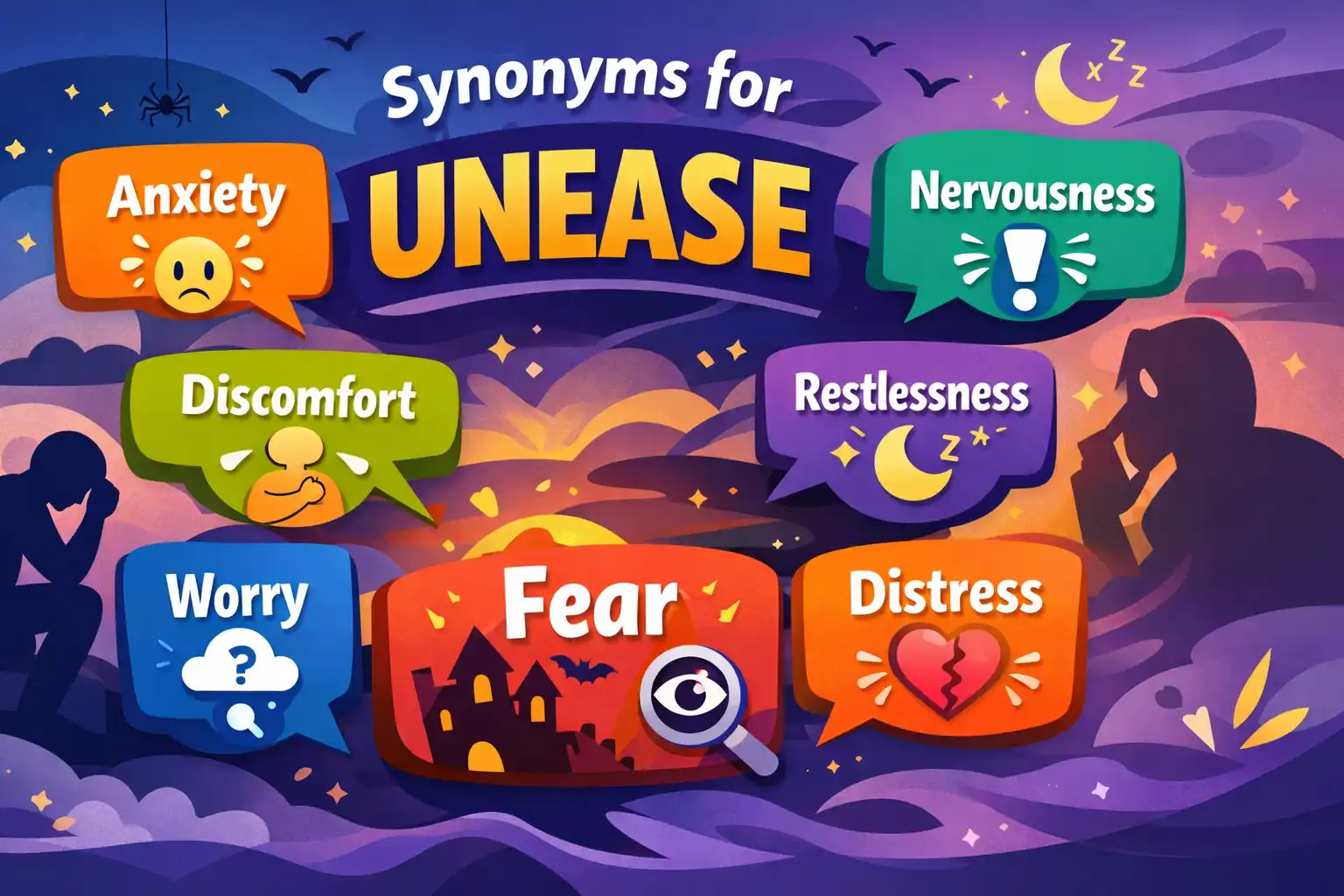
Have you ever walked into a room and suddenly felt a strange tension in the air? Your body feels tight, your mind feels unsure, and something just doesn’t feel right. That feeling is called unease.
For example, you might feel unease before an exam, during a difficult conversation, or when something unexpected happens. Unease means a feeling of discomfort, worry, or nervousness.
Learning synonyms for unease helps you explain emotions more clearly. Students can improve essays, bloggers can write more expressive posts, and content writers can make their stories stronger. Even in daily English, knowing different words for unease helps you describe feelings in a better way.
Below are 50 useful synonyms for unease with simple meanings and easy examples.
Anxiety
Meaning: A strong feeling of worry about something that may happen.
Examples:
I felt anxiety before the job interview.
Her anxiety grew while waiting for the test results.
Worry
Meaning: A feeling of thinking too much about problems.
Examples:
He could not sleep because of worry.
My parents worry about my safety.
Nervousness
Meaning: A shaky feeling when you are afraid or unsure.
Examples:
She felt nervousness before speaking on stage.
My hands showed nervousness during the exam.
Discomfort
Meaning: A feeling that something is not pleasant or easy.
Examples:
I felt discomfort in the silent room.
His question created discomfort at dinner.
Concern
Meaning: A feeling that something may cause trouble.
Examples:
Her face showed concern about the news.
Parents often feel concern for their children.
Tension
Meaning: A tight or stressful feeling in a situation.
Examples:
There was tension during the meeting.
The movie built tension before the big scene.
Fear
Meaning: A strong feeling of being scared.
Examples:
The loud noise caused fear.
She felt fear walking alone at night.
Apprehension
Meaning: A feeling of worry about the future.
Examples:
He waited with apprehension for the result.
She felt apprehension before moving to a new city.
Restlessness
Meaning: A feeling of not being calm or still.
Examples:
I felt restlessness while waiting.
His restlessness made it hard to sit quietly.
Doubt
Meaning: A feeling of not being sure about something.
Examples:
She had doubt about the plan.
His voice showed doubt during the answer.
Uneasiness
Meaning: A mild feeling of worry or discomfort.
Examples:
The dark street gave me uneasiness.
I noticed uneasiness in his smile.
Distress
Meaning: A strong feeling of sadness or worry.
Examples:
The news caused great distress.
She cried in distress after hearing it.
Agitation
Meaning: A feeling of being upset or troubled.
Examples:
The delay caused agitation among passengers.
His voice showed agitation.
Alarm
Meaning: A sudden feeling of fear or danger.
Examples:
The loud shout caused alarm.
Her face showed alarm when she heard the news.
Uneasy Feeling
Meaning: A small sense that something is wrong.
Examples:
I had an uneasy feeling in the room.
The silence gave me an uneasy feeling.
Suspicion
Meaning: A feeling that something may be wrong or dishonest.
Examples:
His story raised suspicion.
She looked at him with suspicion.
Stress
Meaning: A heavy mental pressure.
Examples:
Work stress kept him awake.
Students feel stress before exams.
Pressure
Meaning: A feeling of being pushed to do something.
Examples:
The deadline created pressure.
She felt pressure to succeed.
Uneasy Mood
Meaning: A general feeling of discomfort.
Examples:
The room had an uneasy mood.
His joke created an uneasy mood.
Uneasy Mind
Meaning: A mind full of worry.
Examples:
I went to bed with an uneasy mind.
Her uneasy mind made her quiet.
Worrying Feeling
Meaning: A feeling that something bad may happen.
Examples:
I had a worrying feeling today.
The news gave everyone a worrying feeling.
Nervous Energy
Meaning: Extra energy caused by nervousness.
Examples:
He walked around with nervous energy.
Her nervous energy made her talk fast.
Panic
Meaning: A sudden strong fear.
Examples:
People ran in panic during the fire alarm.
He felt panic when he lost his phone.
Jitters
Meaning: A shaky nervous feeling.
Examples:
I had the jitters before the test.
Her voice showed the jitters.
Uneasy Heart
Meaning: A worried emotional feeling.
Examples:
She left with an uneasy heart.
The message gave him an uneasy heart.
Insecurity
Meaning: A feeling of not being confident.
Examples:
His insecurity showed in his voice.
Social media can cause insecurity.
Dread
Meaning: A strong fear of something coming.
Examples:
She felt dread before the surgery.
Monday mornings fill him with dread.
Uneasy Silence
Meaning: Silence that feels uncomfortable.
Examples:
An uneasy silence filled the room.
We sat in uneasy silence.
Uneasy Calm
Meaning: Calm that feels strange or tense.
Examples:
The town had an uneasy calm.
The storm created an uneasy calm before it began.
Disquiet
Meaning: A feeling of worry or disturbance.
Examples:
The news caused public disquiet.
She felt disquiet all day.
Uneasy Thoughts
Meaning: Thoughts filled with worry.
Examples:
Uneasy thoughts kept him awake.
She tried to ignore uneasy thoughts.
Uneasy Atmosphere
Meaning: A place that feels uncomfortable.
Examples:
The meeting had an uneasy atmosphere.
Guests noticed the uneasy atmosphere.
Uneasy Feeling Inside
Meaning: A quiet worry in your body.
Examples:
I had an uneasy feeling inside.
He could not explain the uneasy feeling inside.
Uneasy Tension
Meaning: Stress mixed with worry.
Examples:
There was uneasy tension in the room.
The argument created uneasy tension.
Uneasy Suspense
Meaning: Waiting with worry.
Examples:
The movie built uneasy suspense.
We waited in uneasy suspense.
Uneasy Concern
Meaning: A worried feeling about something.
Examples:
Parents felt uneasy concern.
His words caused uneasy concern.
Uneasy Awareness
Meaning: Knowing something may be wrong.
Examples:
She had uneasy awareness of danger.
He walked with uneasy awareness.
Uneasy Anticipation
Meaning: Waiting for something with worry.
Examples:
We waited with uneasy anticipation.
The crowd showed uneasy anticipation.
Uneasy Doubt
Meaning: A strong sense of uncertainty.
Examples:
He spoke with uneasy doubt.
Her face showed uneasy doubt.
Uneasy Suspicion
Meaning: A feeling that something is not right.
Examples:
The story caused uneasy suspicion.
She watched him with uneasy suspicion.
Uneasy Curiosity
Meaning: Wanting to know something but feeling worried.
Examples:
I opened the door with uneasy curiosity.
The sound created uneasy curiosity.
Uneasy Expectation
Meaning: Waiting for something with nervous feelings.
Examples:
Students waited with uneasy expectation.
The crowd watched with uneasy expectation.
Uneasy Alertness
Meaning: Being careful because something feels wrong.
Examples:
He walked with uneasy alertness.
Dogs barked with uneasy alertness.
Uneasy Feeling in the Air
Meaning: A shared sense that something is wrong.
Examples:
There was an uneasy feeling in the air.
The news spread an uneasy feeling in the air.
Uneasy State
Meaning: A condition of worry or discomfort.
Examples:
The country was in an uneasy state.
She remained in an uneasy state.
Uneasy Reaction
Meaning: A response showing discomfort.
Examples:
His words caused an uneasy reaction.
People gave uneasy reactions.
Uneasy Situation
Meaning: A moment that feels uncomfortable.
Examples:
The joke created an uneasy situation.
We were stuck in an uneasy situation.
Uneasy Expression
Meaning: A worried look on the face.
Examples:
He had an uneasy expression.
Her uneasy expression worried me.
Uneasy Response
Meaning: A reply showing discomfort.
Examples:
His uneasy response surprised us.
She gave an uneasy response.
Uneasy Feeling of Doubt
Meaning: A mix of worry and uncertainty.
Examples:
I felt an uneasy feeling of doubt.
The plan gave everyone an uneasy feeling of doubt.
Conclusion
Learning synonyms for unease can improve your writing, speaking, and communication. These words help you describe emotions more clearly and make your language richer.
Students can use them in essays, bloggers can create better stories, and writers can make content more engaging. Try using these synonyms in emails, daily conversations, and social media posts to strengthen your English vocabulary.

Andrew Powell is a research-focused editorial writer specializing in word meanings, semantic distinctions, and language accuracy. With a professional background in research-based informational writing, he has built his work around careful analysis of how words function in context and how subtle variations in meaning influence communication.
Andrew’s expertise lies in word comparison and semantic precision. His work examines closely related terms, clarifies usage differences, and explains how context shapes interpretation. Rather than offering surface-level definitions, he approaches language with a structured methodology—reviewing usage patterns, consulting authoritative dictionaries, analyzing corpus data, and evaluating real-world examples. This research-driven process ensures that readers receive clear, reliable explanations grounded in linguistic evidence.
A core focus of his writing is helping readers understand meaning differences that are often overlooked. Whether distinguishing between near-synonyms, exploring formal versus informal usage, or clarifying nuanced grammatical structures, Andrew aims to remove ambiguity. His explanations are designed to support students, writers, educators, and professionals who rely on precise language in academic, business, or creative contexts.
Andrew contributes to the Word Synonyms niche with an emphasis on clarity, neutrality, and factual accuracy. He prioritizes language accuracy over simplification and avoids unsupported claims. Each piece is structured to answer specific user queries while maintaining contextual depth, aligning with current search quality standards and semantic SEO principles.
By combining research-based writing with careful editorial standards, Andrew Powell helps readers develop stronger vocabulary awareness and make informed word choices. His work reflects a commitment to trustworthy information, thoughtful analysis, and practical value for anyone seeking a deeper understanding of English semantics.