Micro Introduction
The word superb appears often in everyday conversation, reviews, academic writing, and online content. People use it to describe something extremely good or impressive.
Learning synonyms for superb helps you avoid repetition and express ideas more clearly. It also improves writing quality and vocabulary for ESL learners.
Direct Answer
Superb means extremely good, impressive, or excellent in quality. It describes something that stands out because of its high standard.
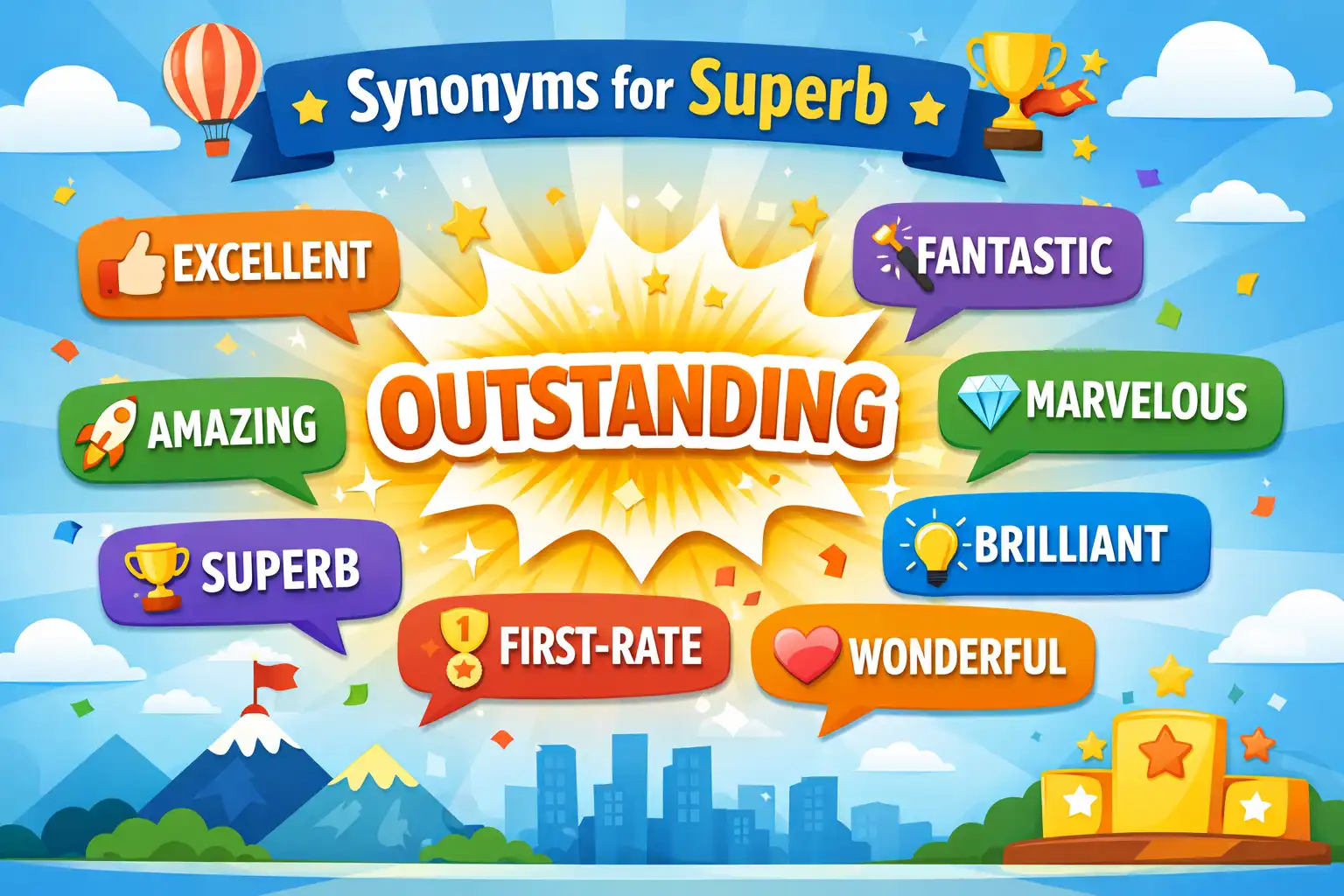
Common synonyms include:
- Excellent
- Outstanding
- Magnificent
- Fantastic
- Terrific
- Exceptional
- Marvelous
- Brilliant
- Splendid
- Wonderful
- Great
- First-rate
- Stellar
- Phenomenal
Meaning of Superb
The word superb describes something of very high quality or impressive excellence. People often use it to praise performance, design, food, or experiences.
Example:
The restaurant served a superb meal that impressed every guest.
Categories of Synonyms
Different synonyms for superb fit different contexts. Understanding these groups helps you choose the best word.
Quality and Performance
These words describe something that performs extremely well or reaches a high standard. They often appear in reviews, work evaluations, and academic writing.
Examples include excellent, outstanding, and exceptional.
Appearance or Style
Some synonyms highlight beauty, design, or visual impact. They describe something elegant or impressive to look at.
Examples include magnificent, splendid, and marvelous.
Experience or Emotion
Other synonyms emphasize how enjoyable or exciting something feels. They appear often in conversations or informal writing.
Examples include fantastic, terrific, and wonderful.
Synonyms Table
| Word | Simple Meaning | Example Sentence |
|---|---|---|
| Excellent | Extremely good quality | She gave an excellent presentation. |
| Outstanding | Better than most others | The student showed outstanding skills. |
| Magnificent | Very beautiful or impressive | The palace looked magnificent at sunset. |
| Fantastic | Extremely good or enjoyable | We had a fantastic weekend trip. |
| Exceptional | Much better than normal | His talent is exceptional for his age. |
| Brilliant | Very impressive or clever | The scientist had a brilliant idea. |
| Splendid | Very impressive or beautiful | The hotel offers splendid views. |
| Phenomenal | Extremely successful or impressive | The athlete had a phenomenal season. |
Master Synonyms List (Grouped by Level)
Beginner / Simple Synonyms
Excellent
Meaning: Very good in quality
Example: The teacher said my essay was excellent.
Great
Meaning: Very good or impressive
Example: They did a great job on the project.
Wonderful
Meaning: Extremely pleasant or enjoyable
Example: We had a wonderful dinner together.
Fantastic (Informal)
Meaning: Extremely good or exciting
Example: The concert was fantastic last night.
Terrific (Informal)
Meaning: Very impressive or enjoyable
Example: She did a terrific job on the report.
Intermediate Synonyms
Outstanding
Meaning: Better than most others
Example: His performance in the match was outstanding.
Marvelous
Meaning: Extremely good or delightful
Example: The chef prepared a marvelous dessert.
Brilliant
Meaning: Very impressive, intelligent, or successful
Example: The engineer developed a brilliant solution.
Splendid (Formal)
Meaning: Very impressive or beautiful
Example: The garden looked splendid in spring.
Advanced / Formal Synonyms
Exceptional (Formal)
Meaning: Unusually excellent or rare in quality
Example: Her leadership skills are exceptional.
Magnificent (Formal)
Meaning: Extremely impressive or grand
Example: The museum displays magnificent artwork.
First-rate
Meaning: Of the highest quality
Example: The company offers first-rate customer service.
Stellar
Meaning: Extremely impressive or successful
Example: She received stellar reviews for her performance.
Phenomenal
Meaning: Remarkably impressive or extraordinary
Example: The startup achieved phenomenal growth.
Formal vs Informal Synonyms
Choosing the right synonym depends on the situation.
Informal synonyms are common in daily speech and casual writing. These include words like fantastic, terrific, and great. People often use them in conversations, blogs, or social media.
Formal synonyms appear more often in professional or academic writing. Words such as exceptional, magnificent, and splendid sound more polished and professional.
For example:
- Casual: “The movie was fantastic.”
- Formal: “The film delivered an exceptional performance.”
Understanding tone helps you choose vocabulary that fits the audience.
Real-Life Usage Examples
Conversation
“That restaurant was superb. I want to go there again.”
Academic Writing
“The research presents superb evidence supporting the theory.”
Business Writing
“Our team delivered superb results during the last quarter.”
Blogging
“This camera offers superb image quality for travel photography.”
Emotional Expression
“You did a superb job. I am really proud of your work.”
Similar Words Comparison
Superb vs Excellent
Both words describe high quality, but excellent is more common and slightly less intense.
Example:
The hotel service was excellent.
The luxury suite was superb.
Superb vs Outstanding
Outstanding focuses on something that stands above others.
Example:
Her research paper was outstanding among the class.
The final presentation was superb in quality.
Superb vs Fantastic
Fantastic is more informal and emotional.
Example:
We had a fantastic vacation.
The chef prepared a superb meal.
Example Sentences
Here are natural examples of how the word superb works in real sentences.
- The orchestra delivered a superb performance.
- She showed superb leadership during the project.
- The hotel provides superb customer service.
- His photography skills are superb.
- The chef prepared a superb dinner.
- The movie received superb reviews from critics.
- Their teamwork produced superb results.
- The athlete demonstrated superb control during the match.
- The book offers a superb explanation of the topic.
- The view from the mountain was superb.
- The designer created a superb collection this year.
- Her writing style is superb and easy to read.
- The museum has a superb collection of paintings.
- The team showed superb coordination during the game.
Common Mistakes
Here are mistakes learners often make when using synonyms for superb.
Using Words in the Wrong Tone
Some synonyms sound too casual for professional writing.
Example mistake:
“The research results were fantastic.”
Better:
“The research results were exceptional.”
Overusing the Same Word
Repeating one word like excellent too often can weaken writing. Use different synonyms instead.
Using Rare Words
Very uncommon vocabulary may confuse readers. Stick with commonly used synonyms like outstanding or brilliant.
Mixing Formal and Informal Tone
Avoid mixing styles in the same sentence.
Example mistake:
“The report is phenomenal and kinda great.”
Tips / Best Practices
Use these quick tips when choosing a synonym for superb.
Consider the tone
Formal writing works better with words like exceptional or magnificent.
Think about context
Some words suit performance, while others describe beauty.
Keep clarity first
Choose words your audience understands easily.
Avoid overuse
Repeating one adjective too often weakens writing. Use a variety of synonyms instead.
When NOT to Use Superb
Sometimes the word superb may not fit the context.
Avoid using it when describing:
- Ordinary situations
- Neutral facts
- Negative events
Example:
Incorrect: “The traffic jam was superb.”
Correct: “The traffic jam was terrible.”
The word usually expresses strong praise.
Opposite Words (Antonyms)
Antonyms help you understand meaning more clearly.
Common opposites of superb include:
- Poor
- Terrible
- Awful
- Mediocre
- Inferior
- Bad
Example:
The previous design was mediocre, but the new version is superb.
FAQs
What does superb mean?
Superb means extremely good, impressive, or of very high quality.
Is superb formal or informal?
It works in both formal and informal contexts. However, it often sounds slightly more formal than words like great.
How can I use superb in conversation?
You can say: “The dinner was superb” or “You did a superb job.”
What is the best synonym for superb?
Common choices include excellent, outstanding, and exceptional.
Can superb be replaced with excellent?
Yes. Both describe very high quality, though superb can sound slightly stronger.
Is superb stronger than good?
Yes. Superb expresses a much higher level of quality than good.
Can superb describe people?
Yes. It often describes someone’s performance or skills.
Example:
“She showed superb leadership.”
Is superb common in reviews?
Yes. People frequently use it in restaurant, movie, or product reviews.
Can superb describe experiences?
Yes. It often describes trips, meals, performances, or events.
Should I use superb in academic writing?
Yes, but moderately. Words like exceptional or outstanding may sound more formal.
Conclusion
Learning synonyms for superb expands your vocabulary and improves communication. Instead of repeating the same adjective, you can choose alternatives that better match tone, context, and formality.
Strong vocabulary helps you write clearer essays, better blog posts, and more engaging conversations. Try using three new synonyms for superb in your next sentence to strengthen your English skills.

Andrew Powell is a research-focused editorial writer specializing in word meanings, semantic distinctions, and language accuracy. With a professional background in research-based informational writing, he has built his work around careful analysis of how words function in context and how subtle variations in meaning influence communication.
Andrew’s expertise lies in word comparison and semantic precision. His work examines closely related terms, clarifies usage differences, and explains how context shapes interpretation. Rather than offering surface-level definitions, he approaches language with a structured methodology—reviewing usage patterns, consulting authoritative dictionaries, analyzing corpus data, and evaluating real-world examples. This research-driven process ensures that readers receive clear, reliable explanations grounded in linguistic evidence.
A core focus of his writing is helping readers understand meaning differences that are often overlooked. Whether distinguishing between near-synonyms, exploring formal versus informal usage, or clarifying nuanced grammatical structures, Andrew aims to remove ambiguity. His explanations are designed to support students, writers, educators, and professionals who rely on precise language in academic, business, or creative contexts.
Andrew contributes to the Word Synonyms niche with an emphasis on clarity, neutrality, and factual accuracy. He prioritizes language accuracy over simplification and avoids unsupported claims. Each piece is structured to answer specific user queries while maintaining contextual depth, aligning with current search quality standards and semantic SEO principles.
By combining research-based writing with careful editorial standards, Andrew Powell helps readers develop stronger vocabulary awareness and make informed word choices. His work reflects a commitment to trustworthy information, thoughtful analysis, and practical value for anyone seeking a deeper understanding of English semantics.