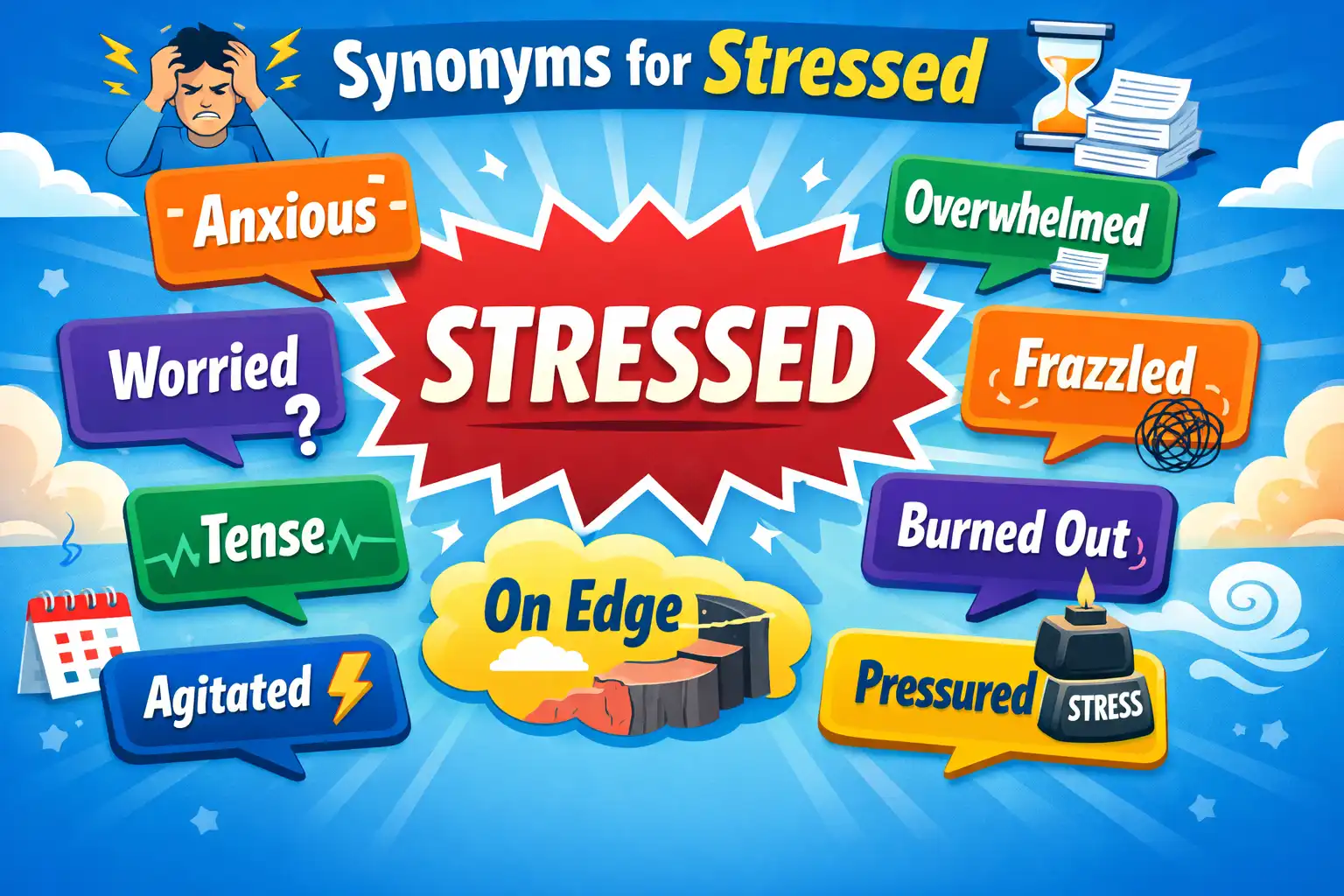
Common synonyms for ‘stressed’ include:
- Anxious
- Overwhelmed
- Tense
- Strained
- Worried
- Frazzled
- Pressured
- Burdened
Meaning of Stressed
The word “stressed” refers to a state of mental or emotional strain caused by challenging situations or excessive demands. It often implies feeling tense, anxious, or under pressure. People use it to describe feelings of worry or being unable to cope with responsibilities or emotional load.
Example sentences:
- After the presentation, I felt so stressed about the feedback I might receive.
- She was stressed out from the constant deadlines at work.
Synonyms Table
| Word | Meaning | Example |
| Anxious | Feeling uneasy or worried about something | She felt anxious about the upcoming job interview. |
| Overwhelmed | Feeling unable to handle a large amount of tasks or emotions | He was overwhelmed by the amount of work piling up. |
| Tense | Physically or mentally strained, often due to anxiety | The atmosphere was tense before the big exam. |
| Strained | Under physical or emotional pressure | His voice sounded strained after the long meeting. |
| Worried | Concerned about a potential problem or outcome | He was worried about his family’s health. |
| Frazzled | Extremely tired and stressed from being overworked | After the long week, she felt completely frazzled. |
| Pressured | Feeling pushed to meet expectations or deadlines | The manager made me feel pressured to complete the project. |
| Burdened | Carrying a heavy emotional or mental load | She was burdened by the responsibilities at home and work. |
Formal and Informal Synonyms
Formal Synonyms:
- Tense
- Strained
- Overwhelmed
- Burdened
These synonyms typically used in professional or academic writing. They carry a more serious tone and fit well in discussions of stress in high-pressure environments.
Informal Synonyms:
- Frazzled
- Pressured
- Anxious
- Worried
These words are often found in casual conversation or in writing that is more personal. They tend to express stress in everyday situations and often emphasize emotional discomfort or concern.
Context Usage Section
In Conversations:
When we talk about stress in daily life, we often use casual synonyms like “frazzled” or “pressured” to express how we feel about the challenges we face. For example, you might hear, “I’m feeling frazzled after running errands all day.”
In Writing:
In more formal writing, such as business emails or academic papers, terms like “overwhelmed” and “strained” are more suitable. For instance, “The team is feeling overwhelmed due to the tight project deadline.”
In Emotional Expression:
When expressing emotions related to stress, words like “anxious” or “worried” are commonly used to reflect specific concerns or fears. An example might be, “I’m worried about how this situation will unfold.”
Comparison Section
Stressed vs Anxious
While both “stressed” and “anxious” describe negative emotional states, “stressed” refers to a general feeling of being under pressure, often from external sources. “Anxious,” on the other hand, typically conveys a feeling of unease or fear about uncertain events.
- Stressed: “She felt stressed about managing her job and family life.”
- Anxious: “He felt anxious about speaking in front of a large audience.”
Stressed vs Overwhelmed
“Stressed” is a broader term used for various pressures, while “overwhelmed” specifically implies a feeling of being unable to cope with too many tasks or emotions at once.
- Stressed: “I am feeling stressed after the long day.”
- Overwhelmed: “She overwhelmed by the number of emails she needed to respond to.”
Example Sentences
- I feel anxious before every big presentation.
- After the wedding planning, I completely frazzled.
- She overwhelmed by all the things she had to get done before the event.
- He so pressured to meet the expectations of his boss.
- I was tense during the interview but managed to stay calm.
- The constant deadlines at work have left me feeling strained.
- I am feeling worried about the upcoming project review.
- After the long meeting, I felt mentally burdened.
- My friend looked frazzled after managing her kids and work all day.
- He tense about the big decision he had to make.
- I felt so pressured to make the right choice that I couldn’t think clearly.
- She anxious about whether she would be accepted into the program.
- They felt overwhelmed by the emotional weight of the situation.
- The workload is strained as we try to meet our goals.
- He has been under burdened conditions at work for weeks.
Common Mistakes
- Overusing “Stressed” in Casual Contexts: Sometimes learners may overuse “stressed” when simpler words like “worried” or “anxious” would work better in a conversation.
- Confusing “Strained” with “Overwhelmed”: While both describe a level of discomfort, “strained” is more about physical or mental pressure, while “overwhelmed” implies too much to handle.
- Using Formal Synonyms in Informal Settings: Words like “tense” or “burdened” may sound too formal in a casual chat. It’s better to choose something like “frazzled” or “pressured” in everyday conversations.
FAQ
- What is the best synonym for “stressed” in an informal conversation?
- Frazzled or pressured are great options for informal conversations.
- Can “anxious” replace “stressed”?
- Yes, but “anxious” specifically refers to worry or fear about something, whereas “stressed” can refer to any kind of pressure or strain.
- What synonym is most suitable for professional writing?
- Overwhelmed or strained are ideal for professional or formal writing.
Conclusion
In summary, there are many synonyms for “stressed” that can be used depending on the situation and the formality of the conversation or writing. Words like “frazzled” and “pressured” fit well in informal contexts, while “overwhelmed” and “strained” are more appropriate in formal settings. Understanding the subtle differences between these synonyms can help you communicate more effectively, whether you’re expressing personal feelings or writing professionally.

Andrew Powell is a research-focused editorial writer specializing in word meanings, semantic distinctions, and language accuracy. With a professional background in research-based informational writing, he has built his work around careful analysis of how words function in context and how subtle variations in meaning influence communication.
Andrew’s expertise lies in word comparison and semantic precision. His work examines closely related terms, clarifies usage differences, and explains how context shapes interpretation. Rather than offering surface-level definitions, he approaches language with a structured methodology—reviewing usage patterns, consulting authoritative dictionaries, analyzing corpus data, and evaluating real-world examples. This research-driven process ensures that readers receive clear, reliable explanations grounded in linguistic evidence.
A core focus of his writing is helping readers understand meaning differences that are often overlooked. Whether distinguishing between near-synonyms, exploring formal versus informal usage, or clarifying nuanced grammatical structures, Andrew aims to remove ambiguity. His explanations are designed to support students, writers, educators, and professionals who rely on precise language in academic, business, or creative contexts.
Andrew contributes to the Word Synonyms niche with an emphasis on clarity, neutrality, and factual accuracy. He prioritizes language accuracy over simplification and avoids unsupported claims. Each piece is structured to answer specific user queries while maintaining contextual depth, aligning with current search quality standards and semantic SEO principles.
By combining research-based writing with careful editorial standards, Andrew Powell helps readers develop stronger vocabulary awareness and make informed word choices. His work reflects a commitment to trustworthy information, thoughtful analysis, and practical value for anyone seeking a deeper understanding of English semantics.