Micro Introduction
The word splendorous appears in descriptive writing, formal speech, and expressive English.
Learning synonyms for it helps you sound more precise and natural.
This guide explains meaning, usage, and better word choices clearly.
Direct Answer
Splendorous means very beautiful, impressive, or full of brilliance.
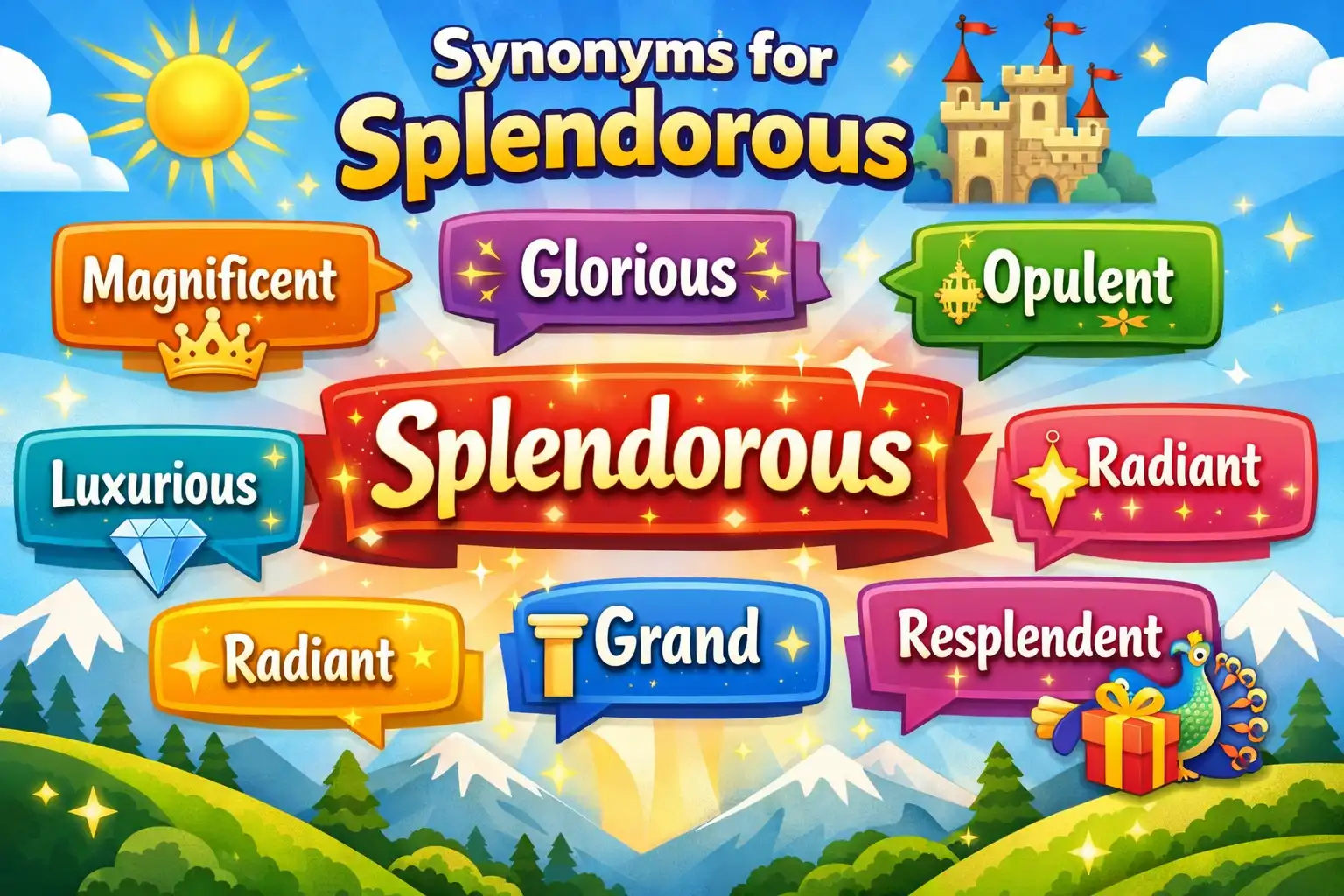
Common synonyms include:
- Magnificent
- Resplendent
- Glorious
- Stunning
- Spectacular
Meaning of Splendorous
Splendorous describes something that looks grand, rich, or visually impressive.
It is often used for places, events, clothing, or moments.
Example:
The palace looked splendorous in the evening light.
Is Splendorous a Word?
Yes, splendorous is a real English word.
It is correct but less common than splendid or magnificent.
It appears more often in formal or literary writing.
Categories of Synonyms for Splendorous (By Meaning Type)
Visual Beauty
Used for appearance, scenery, or design.
Examples focus on color, light, or form.
Grandeur and Scale
Used for size, importance, or impressive presence.
Common in architecture or events.
Quality and Excellence
Used for achievements, performance, or results.
Often appears in formal or academic writing.
Synonyms Table
| Word | Simple Meaning | Example Sentence |
| Magnificent | Very impressive or beautiful | The hall was magnificent. |
| Resplendent | Shining with beauty | She looked resplendent in gold. |
| Glorious | Worthy of praise | It was a glorious victory. |
| Stunning | Extremely attractive | The view was stunning. |
| Spectacular | Dramatic and exciting | The show was spectacular. |
Master Synonyms List (Grouped by Level)
Beginner / Simple
- Beautiful – very pleasing to look at
→ The garden looked beautiful in spring. (Informal) - Amazing – causing surprise or admiration
→ The fireworks were amazing. (Informal) - Wonderful – very good or enjoyable
→ We had a wonderful evening. (Neutral)
Intermediate
- Magnificent – grand and impressive
→ The magnificent building stood tall. (Formal) - Stunning – extremely attractive
→ Her dress was stunning. (Neutral) - Glorious – highly admired
→ It was a glorious sunrise. (Formal)
Advanced / Formal
- Resplendent – shining with beauty
→ The hall was resplendent with lights. (Formal) - Spectacular – visually dramatic
→ The launch was spectacular. (Formal) - Splendiferous – very impressive (informal but accepted)
→ The parade looked splendiferous. (Informal)
Formal vs Informal Synonyms
- Use resplendent, magnificent, or glorious in academic or professional writing.
- Use amazing, beautiful, or stunning in daily conversation.
- Avoid splendorous in casual chat unless you want a dramatic tone.
Real-Life Usage Examples
Conversation:
That sunset was stunning.
Academic Writing:
The structure represents a magnificent example of classical design.
Business Writing:
The company achieved spectacular growth this year.
Blogging:
We visited a resplendent historic site.
Emotional Expression:
It was a glorious moment for our family.
Similar Words Comparison
Splendorousvs Magnificent
- Splendorous focuses on beauty and brilliance.
- Magnificent emphasizes size, power, or importance.
Example:
A splendorous dress vs a magnificent building.
Splendorousvs Resplendent
- Resplendent suggests light or shine.
- Splendorous is broader and more general.
Example:
Resplendent jewelry vs a splendorous celebration.
Example Sentences
- The city looked splendorous at night.
- She wore a resplendent gown.
- The performance was spectacular.
- We admired the magnificent cathedral.
- It was a glorious achievement.
- The festival felt splendiferous.
- The painting is stunning.
- The view from the hill was amazing.
- The palace remains beautiful.
- His success story is wonderful.
- The hall appeared resplendent with candles.
- The finale was spectacular.
- The moment felt glorious.
- The wedding décor looked splendorous.
Common Mistakes
- Using splendorous in casual texting.
- Repeating the same synonym too often.
- Using formal words in informal contexts.
- Confusing beauty with size or power.
- Choosing rare words without understanding tone.
Tips / Best Practices
- Match the word to the context.
- Choose simpler words for speech.
- Use formal synonyms in writing.
- Avoid overusing strong adjectives.
- Focus on clarity, not decoration.
When NOT to Use Splendorous
- In technical writing
- In casual conversation
- When describing negative situations
- When a simple word is clearer
Opposite Words (Antonyms)
- Plain
- Ordinary
- Dull
- Unimpressive
- Simple
FAQs
What is a synonym for splendorous?
Common synonyms include magnificent, resplendent, and glorious.
What is the meaning of splendorous?
It means very beautiful, impressive, or grand.
What is another word for splendiferous?
You can use spectacular or magnificent.
Is splendorous formal or informal?
It is mostly formal and literary.
Can splendorous be replaced with splendid?
Yes, splendid is more common and natural.
Conclusion
Learning synonyms for splendorous improves writing clarity and expression.
You gain flexibility, tone control, and better communication.
Try using three new synonyms in your next sentence.

Andrew Powell is a research-focused editorial writer specializing in word meanings, semantic distinctions, and language accuracy. With a professional background in research-based informational writing, he has built his work around careful analysis of how words function in context and how subtle variations in meaning influence communication.
Andrew’s expertise lies in word comparison and semantic precision. His work examines closely related terms, clarifies usage differences, and explains how context shapes interpretation. Rather than offering surface-level definitions, he approaches language with a structured methodology—reviewing usage patterns, consulting authoritative dictionaries, analyzing corpus data, and evaluating real-world examples. This research-driven process ensures that readers receive clear, reliable explanations grounded in linguistic evidence.
A core focus of his writing is helping readers understand meaning differences that are often overlooked. Whether distinguishing between near-synonyms, exploring formal versus informal usage, or clarifying nuanced grammatical structures, Andrew aims to remove ambiguity. His explanations are designed to support students, writers, educators, and professionals who rely on precise language in academic, business, or creative contexts.
Andrew contributes to the Word Synonyms niche with an emphasis on clarity, neutrality, and factual accuracy. He prioritizes language accuracy over simplification and avoids unsupported claims. Each piece is structured to answer specific user queries while maintaining contextual depth, aligning with current search quality standards and semantic SEO principles.
By combining research-based writing with careful editorial standards, Andrew Powell helps readers develop stronger vocabulary awareness and make informed word choices. His work reflects a commitment to trustworthy information, thoughtful analysis, and practical value for anyone seeking a deeper understanding of English semantics.