Micro Introduction
The word sheepishly often appears in everyday conversations, stories, and informal writing. It describes how someone behaves when they feel slightly embarrassed or shy.
Learning synonyms for this word helps you sound more natural and precise in English. It also improves both speaking and writing skills for ESL learners and students.
Direct Answer
Meaning of Sheepishly
Sheepishly means behaving in a shy, embarrassed, or slightly ashamed way, often after making a mistake.
Common Synonyms
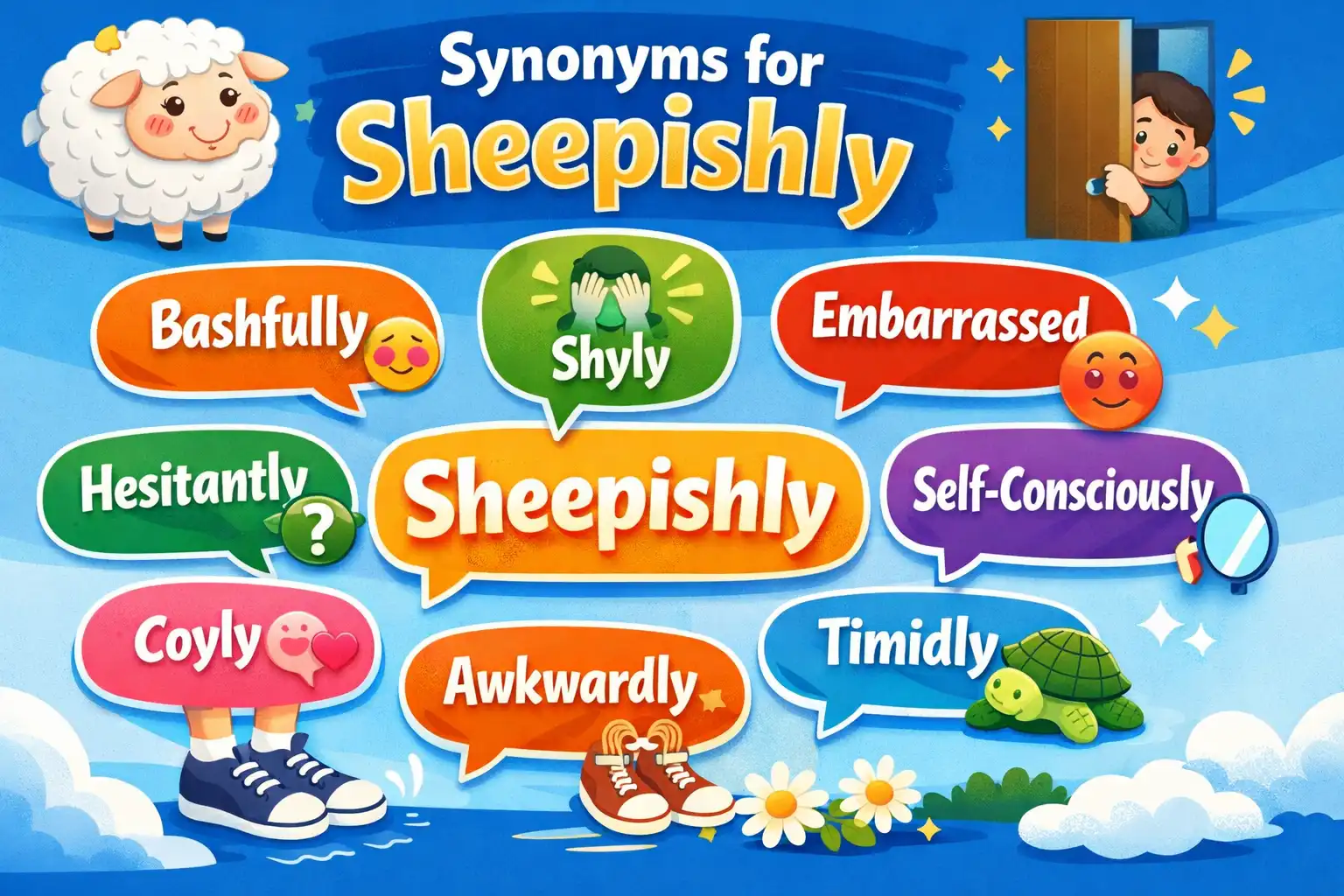
- bashfully
- shyly
- timidly
- awkwardly
- self-consciously
- meekly
- diffidently
- abashedly
Categories of Synonyms
Physical Discomfort
These words describe visible body language such as avoiding eye contact, smiling nervously, or looking down.
Examples include words that show someone feels physically uneasy in a situation.
Emotional Discomfort
Some synonyms highlight inner feelings like embarrassment, guilt, or modesty.
These words focus more on emotional reactions rather than physical behavior.
Social Discomfort
These synonyms describe situations where someone feels shy or uncomfortable in social interactions.
They often appear in conversations, storytelling, and everyday dialogue.
Synonyms Table
| Word | Simple Meaning | Example Sentence |
| bashfully | in a shy and embarrassed way | She bashfully admitted she forgot the meeting. |
| shyly | in a quiet and timid way | He shyly smiled when everyone looked at him. |
| timidly | without confidence | The student timidly asked the teacher a question. |
| awkwardly | in an uncomfortable manner | She awkwardly laughed after dropping her phone. |
| self-consciously | feeling aware or embarrassed | He self-consciously adjusted his glasses. |
| meekly | in a quiet and submissive way | She meekly apologized for the mistake. |
| diffidently | lacking confidence | He diffidently shared his opinion in the meeting. |
| abashedly | feeling embarrassed or ashamed | She abashedly admitted she was wrong. |
Master Synonyms List (Grouped by Level)
Beginner / Simple
Nervously
Simple meaning: feeling worried or uneasy
Example: She nervously explained why she was late.
Hesitantly
Simple meaning: in a slow and unsure way
Example: He hesitantly opened the door and looked inside.
Modestly
Simple meaning: without showing pride
Example: She modestly accepted the compliment.
Intermediate
Uneasily
Simple meaning: feeling uncomfortable or worried
Example: He uneasily looked around the silent room.
Coyly
Simple meaning: pretending to be shy in a playful way
Example: She coyly avoided answering the personal question.
Advanced / Formal
Humbly
Simple meaning: in a respectful or modest manner
Example: He humbly admitted he needed help. (Formal tone)
Formal vs Informal Synonyms
Some synonyms for sheepishly sound more formal than others.
Informal or everyday words
- shyly
- awkwardly
- nervously
These work well in conversations, casual writing, and storytelling.
More formal or academic words
- diffidently
- abashedly
- humbly
These are better for academic essays, professional writing, or formal speeches.
Choosing the right synonym depends on the situation and tone of your sentence.
Real-Life Usage Examples
Conversation
“I forgot to send the email,” he said shyly.
Academic Writing
The participant responded diffidently, suggesting uncertainty about the result.
Business Writing
She hesitantly raised a concern about the project timeline.
Blogging
I awkwardly laughed when I realized I had been speaking with the microphone muted.
Emotional Expression
He uneasily apologized after realizing his comment hurt someone.
Similar Words Comparison
Sheepishly vs Bashfully
Sheepishly usually suggests embarrassment after doing something wrong.
Example:
He sheepishly admitted he forgot the assignment.
Bashfully focuses more on natural shyness rather than guilt.
Example:
She bashfully accepted the compliment.
Key difference:
- Sheepishly → embarrassment or mild shame
- Bashfully → shy reaction to attention
Sheepishly vs Awkwardly
Sheepishly shows emotional embarrassment.
Example:
He smiled sheepishly after being caught daydreaming.
Awkwardly focuses more on uncomfortable behavior.
Example:
She awkwardly tried to explain the mistake.
Key difference:
- Sheepishly → emotional embarrassment
- Awkwardly → socially uncomfortable actions
Example Sentences
- He smiled sheepishly after realizing his joke was inappropriate.
- She looked sheepishly at the teacher after arriving late.
- The child sheepishly admitted breaking the window.
- He scratched his head sheepishly when he forgot her name.
- She laughed sheepishly after telling the wrong story.
- He sheepishly apologized for interrupting the meeting.
- The student sheepishly handed in the late assignment.
- She glanced sheepishly at her friend for help.
- He stood sheepishly at the door after knocking too loudly.
- She smiled sheepishly when everyone started clapping.
- He looked sheepishly at the broken chair.
- She sheepishly admitted she misunderstood the instructions.
- He waved sheepishly after entering the wrong room.
- The boy sheepishly returned the borrowed book.
- She sheepishly confessed she had eaten the last cookie.
Common Mistakes
1. Using Sheepishly for Serious Shame
This word describes mild embarrassment, not deep guilt.
Incorrect:
He spoke sheepishly about the crime.
Better:
He spoke guiltily about the crime.
2. Confusing It With “Shyly”
While similar, shyly does not always include embarrassment.
Example difference:
She spoke shyly at the party.
He smiled sheepishly after making a mistake.
3. Overusing the Word
Repeating the same adverb weakens writing.
Instead of repeating sheepishly, alternate with synonyms like awkwardly or timidly.
4. Using It in Very Formal Writing
Some academic contexts prefer more neutral wording such as reluctantly or hesitantly.
5. Placing It Incorrectly
Adverbs usually appear near the verb.
Correct:
He sheepishly admitted the mistake.
Not ideal:
He admitted the mistake sheepishly during.
Tips for Choosing the Right Synonym
Consider the Tone
Ask whether the situation is casual, emotional, or formal.
Think About Context
Some words describe shyness, while others describe embarrassment.
Match Formality
- Conversations → shyly, awkwardly
- Academic writing → diffidently
- Professional tone → hesitantly
Focus on Clarity
Choose the word that clearly shows the character’s feelings.
Avoid Overuse
Using the same adverb repeatedly can make writing feel repetitive.
Vary your vocabulary naturally instead of forcing keywords.
When NOT to Use Sheepishly
Avoid this word when the situation involves:
- serious guilt
- anger or frustration
- confident actions
- neutral descriptions
Example of misuse:
Incorrect:
He sheepishly gave a confident presentation.
Better:
He confidently delivered the presentation.
Opposite Words (Antonyms)
Words that express the opposite meaning include:
- confidently
- boldly
- proudly
- assertively
- firmly
Example:
She spoke confidently instead of sheepishly.
FAQs
What does sheepishly mean?
It means behaving in a shy, embarrassed, or slightly ashamed way, usually after making a mistake.
Is sheepishly formal or informal?
It is generally neutral but used more often in everyday conversation and storytelling.
How can I use sheepishly in conversation?
You can use it when describing a shy or embarrassed reaction.
Example: “I forgot the keys,” he said sheepishly.
What is the best synonym for sheepishly?
Common choices include bashfully, shyly, timidly, and awkwardly.
Can sheepishly be replaced with shyly?
Yes, but shyly focuses on natural shyness, while sheepishly often suggests embarrassment.
Is sheepishly a negative word?
Not necessarily. It usually describes mild embarrassment rather than something serious.
Can sheepishly describe body language?
Yes. It often appears with actions like smiling, looking down, or scratching the head.
Is sheepishly common in spoken English?
Yes. Native speakers often use it when telling stories about small mistakes.
Can I use sheepishly in academic writing?
It can appear in narrative or descriptive writing, but more formal synonyms may be preferred in research papers.
What part of speech is sheepishly?
It is an adverb that describes how an action is performed.
Conclusion
Learning synonyms for sheepishly helps you express embarrassment, shyness, and social discomfort more clearly. Using alternatives like bashfully, awkwardly, or diffidently can make your writing more precise and natural.
Strong vocabulary improves both speaking and writing skills. Try using three new synonyms from this list in your next sentence to practice.

Andrew Powell is a research-focused editorial writer specializing in word meanings, semantic distinctions, and language accuracy. With a professional background in research-based informational writing, he has built his work around careful analysis of how words function in context and how subtle variations in meaning influence communication.
Andrew’s expertise lies in word comparison and semantic precision. His work examines closely related terms, clarifies usage differences, and explains how context shapes interpretation. Rather than offering surface-level definitions, he approaches language with a structured methodology—reviewing usage patterns, consulting authoritative dictionaries, analyzing corpus data, and evaluating real-world examples. This research-driven process ensures that readers receive clear, reliable explanations grounded in linguistic evidence.
A core focus of his writing is helping readers understand meaning differences that are often overlooked. Whether distinguishing between near-synonyms, exploring formal versus informal usage, or clarifying nuanced grammatical structures, Andrew aims to remove ambiguity. His explanations are designed to support students, writers, educators, and professionals who rely on precise language in academic, business, or creative contexts.
Andrew contributes to the Word Synonyms niche with an emphasis on clarity, neutrality, and factual accuracy. He prioritizes language accuracy over simplification and avoids unsupported claims. Each piece is structured to answer specific user queries while maintaining contextual depth, aligning with current search quality standards and semantic SEO principles.
By combining research-based writing with careful editorial standards, Andrew Powell helps readers develop stronger vocabulary awareness and make informed word choices. His work reflects a commitment to trustworthy information, thoughtful analysis, and practical value for anyone seeking a deeper understanding of English semantics.