Micro Introduction
The word regal often appears in books, formal writing, and descriptions of kings, queens, or impressive people. It describes something that looks royal, noble, or grand.
Learning synonyms for regal helps writers and English learners express elegance and authority more clearly.
Direct Answer
Regal means royal, majestic, or impressive in a way that resembles a king or queen. It often describes appearance, behavior, or style.
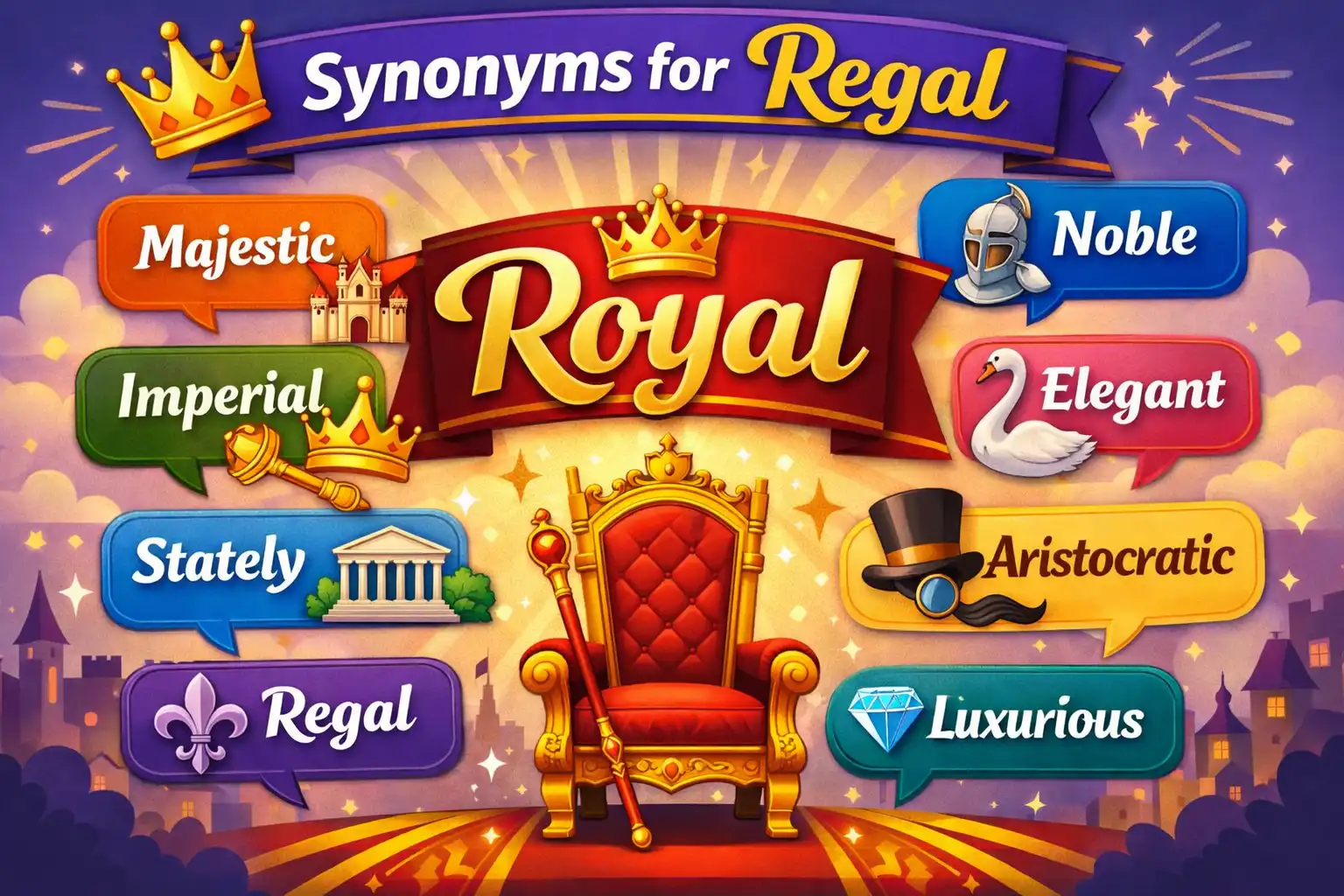
Common synonyms for regal include:
- Royal
- Majestic
- Noble
- Grand
- Dignified
- Imperial
- Stately
- Aristocratic
- Magnificent
- Sovereign
Meaning of Regal
The word regal describes someone or something that looks royal, dignified, and impressive, similar to a king or queen.
It often refers to appearance, posture, attitude, or surroundings that feel noble and powerful.
Example sentence:
She walked into the room with a regal posture that immediately drew attention.
Categories of Synonyms for Regal
Royal Authority
These synonyms emphasize power, monarchy, or ruling status. They are often used when describing kings, queens, or leadership connected to royalty.
Examples include royal, imperial, and sovereign.
Noble Character
Some synonyms focus on dignity, honor, and noble behavior rather than political power.
Examples include noble, dignified, and aristocratic.
Grand Appearance
Other synonyms highlight beauty, elegance, and impressive style.
Examples include majestic, stately, magnificent, and grand.
Synonyms Table
| Word | Simple Meaning | Example Sentence |
| Royal | related to a king or queen | The palace had a truly royal atmosphere. |
| Majestic | very grand and impressive | The mountains looked majestic at sunrise. |
| Noble | honorable and dignified | His noble actions inspired everyone. |
| Grand | impressive and large | They entered the grand hall of the palace. |
| Dignified | calm and respectful | She remained dignified during the ceremony. |
| Imperial | related to an empire or emperor | The museum displayed imperial artifacts. |
| Stately | graceful and impressive | The stately building stood in the city center. |
| Aristocratic | related to high social class | He spoke with an aristocratic confidence. |
| Magnificent | extremely beautiful or impressive | The magnificent castle attracted tourists. |
| Sovereign | possessing supreme authority | The sovereign ruler addressed the nation. |
Master Synonyms List (Grouped by Level)
Beginner / Simple Synonyms
Royal
Meaning: related to a king, queen, or monarchy
Example: The bride looked royal in her elegant dress.
Grand
Meaning: very impressive or large
Example: The hotel lobby felt grand and luxurious.
Noble
Meaning: honorable and dignified
Example: His noble attitude earned respect from everyone.
Intermediate Synonyms
Majestic
Meaning: beautiful and powerful in appearance
Example: The eagle looked majestic as it flew across the sky.
Dignified
Meaning: calm, serious, and respectful
Example: The professor maintained a dignified presence during the debate.
Stately
Meaning: graceful and impressive in a formal way
Example: The mansion had a stately design with tall columns.
Magnificent
Meaning: extremely impressive or beautiful
Example: The palace gardens looked magnificent in spring.
Advanced / Formal Synonyms
Imperial (Formal)
Meaning: related to an emperor or empire
Example: The ceremony reflected imperial traditions.
Aristocratic (Formal)
Meaning: connected to high social class or nobility
Example: Her aristocratic manner impressed the guests.
Sovereign (Formal)
Meaning: having supreme power or authority
Example: The sovereign leader made an important announcement.
Formal vs Informal Synonyms
Choosing the right synonym depends on context and tone.
Informal or everyday synonyms
- Grand
- Noble
- Royal
These work well in conversation or casual writing.
Example:
That hotel looks grand and luxurious.
Formal synonyms
- Imperial
- Aristocratic
- Sovereign
These appear more often in historical writing, academic work, or political discussions.
Example:
The empire followed imperial traditions during ceremonies.
Neutral synonyms
- Majestic
- Stately
- Dignified
- Magnificent
These work well in many types of writing, including descriptions and storytelling.
Real-Life Usage Examples
Conversation
She walked into the wedding hall with a majestic smile.
Academic Writing
The palace architecture reflects imperial influence from the 18th century.
Business Writing
The company headquarters has a stately design that impresses visitors.
Blogging
The hotel lobby felt magnificent with its crystal chandeliers.
Emotional Expression
Her calm and dignified response surprised everyone.
Similar Words Comparison
Regal vs Majestic
Both words describe something impressive, but they focus on different qualities.
Regal suggests royal elegance or authority.
Example: She had a regal posture.
Majestic emphasizes beauty and power in appearance.
Example: The waterfall looked majestic.
Regal vs Noble
These words also overlap but differ in meaning.
Regal describes royal appearance or style.
Example: He carried himself with a regal confidence.
Noble refers to moral character or honor.
Example: Helping others was a noble act.
Example Sentences
- The queen entered the hall with a regal presence.
- The actor stood tall and dignified on stage.
- The palace had a grand staircase made of marble.
- The sunset created a majestic view over the mountains.
- The old mansion looked stately among the trees.
- Her calm voice sounded noble and sincere.
- The castle gardens appeared magnificent during spring.
- The museum displayed imperial treasures from ancient times.
- His confident posture gave him a regal appearance.
- The ceremony followed aristocratic traditions.
- The sovereign ruler addressed the people.
- The bride walked with a majestic elegance.
- The hotel entrance looked grand and welcoming.
- The professor maintained a dignified tone during the lecture.
- The palace interior felt magnificent and luxurious.
Common Mistakes When Using Synonyms for Regal
1. Confusing Appearance with Character
Some learners use regal when they mean noble behavior.
Incorrect:
He made a regal decision to help others.
Better:
He made a noble decision.
2. Overusing “Majestic”
Many people replace regal with majestic every time. However, majestic often describes nature or scenery, not people.
3. Using Formal Words in Casual Speech
Words like sovereign or imperial can sound unnatural in daily conversation.
Instead, use simpler words like royal or grand.
4. Using Regal for Ordinary Situations
Regal should describe something impressive or elegant, not everyday objects.
Incorrect:
My small desk looks regal.
Correct:
My office desk looks elegant.
Tips for Choosing the Right Synonym
Consider the Tone
Formal writing may require words like imperial or aristocratic, while casual speech works better with grand or royal.
Check the Context
Use majestic for landscapes and dignified for behavior.
Think About Formality
Some synonyms sound stronger and more formal than others.
Keep Language Clear
Avoid using many complex synonyms in the same paragraph.
Avoid Overuse
Repeating the same synonym too often can weaken your writing.
Use variety naturally instead.
When NOT to Use Regal
Avoid using regal in situations that do not involve elegance, authority, or dignity.
For example:
- Everyday objects
- Casual or messy situations
- Informal humor
Incorrect example:
His messy desk looked regal.
Correct alternative:
His desk looked impressive.
Opposite Words (Antonyms)
Opposites of regal describe things that are plain or lacking elegance.
Common antonyms include:
- Humble
- Modest
- Ordinary
- Simple
- Common
Example:
Instead of a regal palace, the house looked simple and modest.
FAQs
What does regal mean?
Regal means royal, noble, or impressive in a way that resembles a king or queen.
Is regal formal or informal?
Regal is usually neutral to formal, but it can appear in everyday descriptions.
How can I use regal in conversation?
You can use it to describe elegance or dignity.
Example: She carried herself with a regal confidence.
What is the best synonym for regal?
Common choices include majestic, royal, noble, and stately.
Can regal describe a person?
Yes. It often describes someone with elegant posture, dignity, or authority.
Is majestic the same as regal?
Not exactly. Majestic focuses on beauty and grandeur, while regal emphasizes royal elegance.
Can regal describe places?
Yes. It can describe palaces, buildings, rooms, or decorations that look royal.
Is regal positive or negative?
Regal is usually positive because it suggests dignity and elegance.
What part of speech is regal?
Regal is an adjective.
Can regal describe behavior?
Yes. It can describe dignified or confident behavior.
Conclusion
Learning synonyms for regal helps improve both speaking and writing. Words like majestic, noble, dignified, and stately allow you to describe elegance and authority more precisely.
Expanding your vocabulary also makes your communication clearer and more engaging.
Try using three new synonyms from this list in your next sentence to strengthen your English skills.

Andrew Powell is a research-focused editorial writer specializing in word meanings, semantic distinctions, and language accuracy. With a professional background in research-based informational writing, he has built his work around careful analysis of how words function in context and how subtle variations in meaning influence communication.
Andrew’s expertise lies in word comparison and semantic precision. His work examines closely related terms, clarifies usage differences, and explains how context shapes interpretation. Rather than offering surface-level definitions, he approaches language with a structured methodology—reviewing usage patterns, consulting authoritative dictionaries, analyzing corpus data, and evaluating real-world examples. This research-driven process ensures that readers receive clear, reliable explanations grounded in linguistic evidence.
A core focus of his writing is helping readers understand meaning differences that are often overlooked. Whether distinguishing between near-synonyms, exploring formal versus informal usage, or clarifying nuanced grammatical structures, Andrew aims to remove ambiguity. His explanations are designed to support students, writers, educators, and professionals who rely on precise language in academic, business, or creative contexts.
Andrew contributes to the Word Synonyms niche with an emphasis on clarity, neutrality, and factual accuracy. He prioritizes language accuracy over simplification and avoids unsupported claims. Each piece is structured to answer specific user queries while maintaining contextual depth, aligning with current search quality standards and semantic SEO principles.
By combining research-based writing with careful editorial standards, Andrew Powell helps readers develop stronger vocabulary awareness and make informed word choices. His work reflects a commitment to trustworthy information, thoughtful analysis, and practical value for anyone seeking a deeper understanding of English semantics.