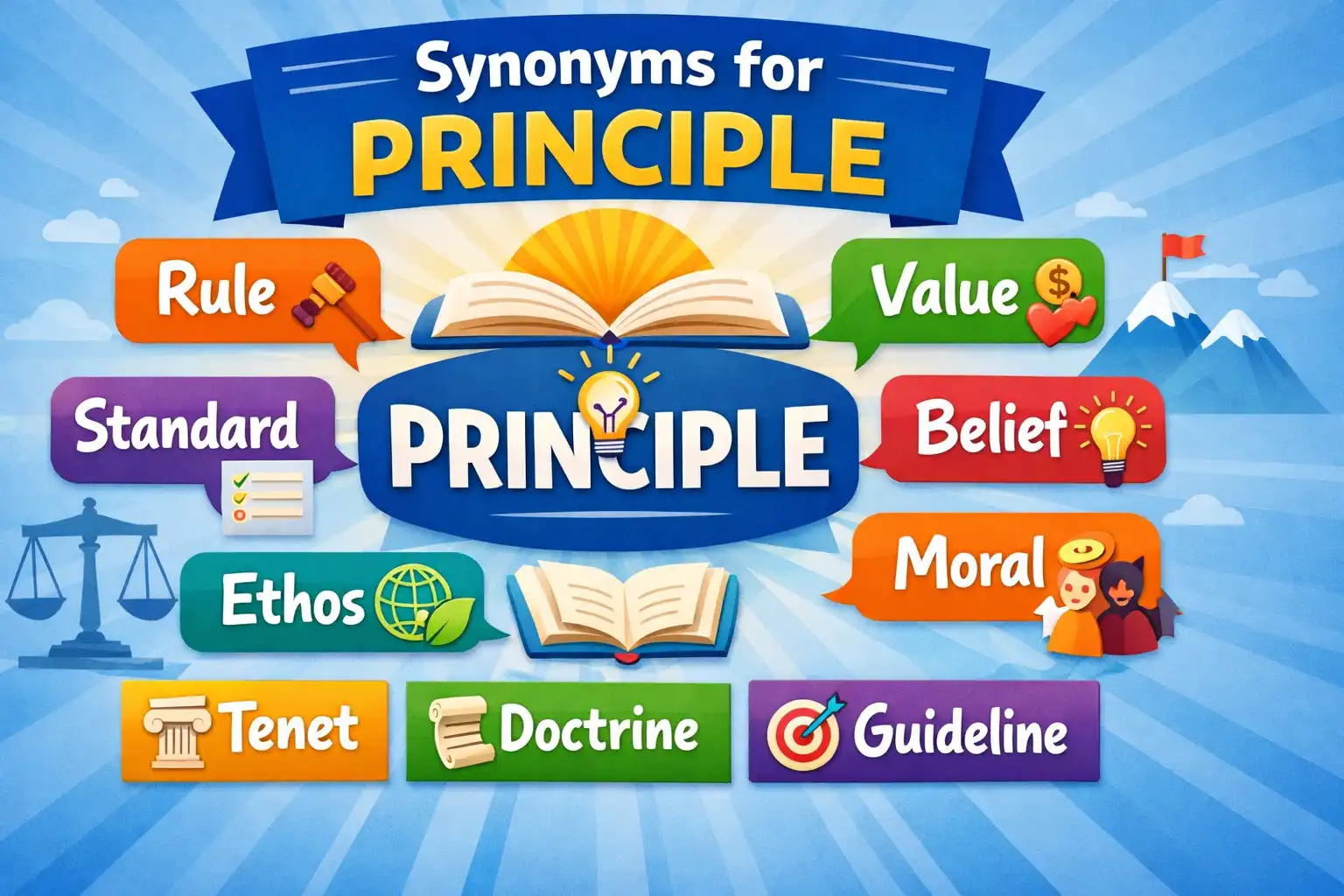
The word principle is commonly used in daily speech, academic writing, and professional communication. Learning its synonyms helps you express ideas more clearly, avoid repetition, and improve both writing and speaking skills.
Direct Answer
A principle is a basic truth, rule, or belief guiding behavior or thought. Common synonyms include:
- Rule
- Law
- Standard
- Guideline
- Tenet
- Doctrine
- Belief
- Value
- Code
- Ethic
Meaning of Principle
A principle is a fundamental idea or rule that guides actions or decisions.
Example: She always follows the principle of honesty in her work.
Principle vs Principal – Quick Note
- Principle – a rule, belief, or basic truth guiding behavior.
Example: She always follows the principle of honesty. - Principal – most important, or a person in charge (like a school principal).
Example 1: He is the principal of the school.
Example 2: The principal reason we succeeded was teamwork.
Tip: If you are talking about a rule, belief, or moral idea, always use principle. If you mean someone in charge or main/primary, use principal.
Types of Synonyms for Principle (Ethics, Rules, Beliefs, Science)
- Moral / Ethical Principles: Words related to beliefs, values, and ethics.
- Rules / Guidelines: Words used for instructions, laws, or standards.
- Philosophical / Scientific Principles: Words describing theories, doctrines, or foundational ideas.
Synonyms Table
| Word | Simple Meaning | Example Sentence |
| Rule | A clear instruction | Follow the rule of not texting while driving. |
| Law | Legal or formal regulation | The law protects citizens’ rights. |
| Standard | Accepted level or quality | This school maintains a high standard of education. |
| Guideline | Suggested method | Use this guideline to write your essay. |
| Tenet | Basic belief or idea | Honesty is a key tenet of their religion. |
| Doctrine | Set of beliefs taught formally | The company follows a strict safety doctrine. |
| Belief | Personal idea or opinion | She has a strong belief in teamwork. |
| Value | Important idea or principle | Respect is a core value in their family. |
| Code | Set of rules or conduct | The office has a strict code of conduct. |
| Ethic | Moral principle | Medical ethics guide all doctors’ decisions. |
Master Synonyms List (Grouped by Level)
Beginner / Simple
- Rule – instruction or guideline – Follow the rule carefully. (Informal/Formal)
- Law – legal requirement – Breaking the law can lead to fines. (Formal)
- Guideline – suggested method – Use the guideline for safety. (Informal/Formal)
Intermediate
- Standard – accepted level – Our work meets the highest standard. (Formal)
- Value – important idea – Honesty is an important value. (Informal/Formal)
- Belief – personal opinion – Her belief shapes her choices. (Informal/Formal)
Advanced / Formal
- Tenet – core principle – A central tenet of democracy is free speech. (Formal)
- Doctrine – taught belief – The military follows strict doctrine. (Formal)
- Code – rules or conduct – The code prohibits conflicts of interest. (Formal)
- Ethic – moral rule – Professional ethics are essential in medicine. (Formal)
Formal vs Informal Synonyms
- Formal: tenet, doctrine, ethic, code, law – used in academic, professional, or legal contexts.
- Informal: rule, guideline, belief, value – suitable for daily speech or casual writing.
Real-Life Usage Examples
- Conversation: “Honesty is a value I respect.”
- Academic Writing: “The tenet of equality underpins the study.”
- Business Writing: “Our code of conduct ensures fairness.”
- Blogging: “Follow this guideline to improve productivity.”
- Emotional Expression: “Her belief in kindness inspires everyone.”
Similar Words Comparison
- Principle vs Rule: Principle is a broader idea; rule is a specific instruction.
Example: Principle: “Honesty matters.” Rule: “Do not lie to clients.” - Principle vs Tenet: Principle is general; tenet is formal and philosophical.
Example: Principle: “Be fair to everyone.” Tenet: “Fairness is a tenet of justice.”
Example Sentences
- She lives by the principle of hard work.
- Always follow the rule in the classroom.
- The law requires everyone to wear a seatbelt.
- Quality is a company standard.
- The teacher provided a guideline for the project.
- Honesty is a tenet of their philosophy.
- Safety doctrine is taught to all employees.
- Personal beliefs shape our decisions.
- Respect is a core value at home.
- The employee handbook contains a strict code.
- Doctors follow professional ethics.
- Integrity is a key principle in leadership.
- The school enforces a dress rule.
- Freedom is a tenet of democracy.
- Teamwork is a shared value among colleagues.
Common Mistakes
- Using rule when you mean a broad principle.
- Confusing tenet with casual belief.
- Replacing ethic with value in formal writing.
- Overusing principle in short texts.
- Misapplying doctrine outside academic or formal contexts.
Tips / Best Practices
- Match tone: formal vs informal.
- Match context: law, philosophy, everyday speech.
- Keep clarity high: don’t choose rare synonyms for casual writing.
- Avoid overusing one synonym to prevent repetition.
When NOT to Use Principle
- Don’t use principle for a minor rule or preference.
- Avoid in casual commands: “Turn off the light; it’s a principle!” ❌
- Avoid replacing law in legal contexts.
Opposite Words (Antonyms)
- Exception
- Rule-break
- Corruption
- Immorality
- Flexibility (in rules or behavior)
FAQs
Q: What does principle mean?
A: A fundamental truth or rule guiding behavior or thought.
Q: Is principle formal or informal?
A: Neutral, but often used in formal contexts.
Q: How can I use it in conversation?
A: “I follow the principle of honesty every day.”
Q: What is the best synonym for principle?
A: Rule, tenet, or value depending on context.
Q: Can principle be replaced with guideline?
A: Sometimes, in informal or instructional contexts, yes.
Conclusion
Learning synonyms for principle improves clarity, writing, and speaking. You can express ideas more precisely in conversation, essays, and professional work.
Try using 3 new synonyms in your next sentence.

Andrew Powell is a research-focused editorial writer specializing in word meanings, semantic distinctions, and language accuracy. With a professional background in research-based informational writing, he has built his work around careful analysis of how words function in context and how subtle variations in meaning influence communication.
Andrew’s expertise lies in word comparison and semantic precision. His work examines closely related terms, clarifies usage differences, and explains how context shapes interpretation. Rather than offering surface-level definitions, he approaches language with a structured methodology—reviewing usage patterns, consulting authoritative dictionaries, analyzing corpus data, and evaluating real-world examples. This research-driven process ensures that readers receive clear, reliable explanations grounded in linguistic evidence.
A core focus of his writing is helping readers understand meaning differences that are often overlooked. Whether distinguishing between near-synonyms, exploring formal versus informal usage, or clarifying nuanced grammatical structures, Andrew aims to remove ambiguity. His explanations are designed to support students, writers, educators, and professionals who rely on precise language in academic, business, or creative contexts.
Andrew contributes to the Word Synonyms niche with an emphasis on clarity, neutrality, and factual accuracy. He prioritizes language accuracy over simplification and avoids unsupported claims. Each piece is structured to answer specific user queries while maintaining contextual depth, aligning with current search quality standards and semantic SEO principles.
By combining research-based writing with careful editorial standards, Andrew Powell helps readers develop stronger vocabulary awareness and make informed word choices. His work reflects a commitment to trustworthy information, thoughtful analysis, and practical value for anyone seeking a deeper understanding of English semantics.