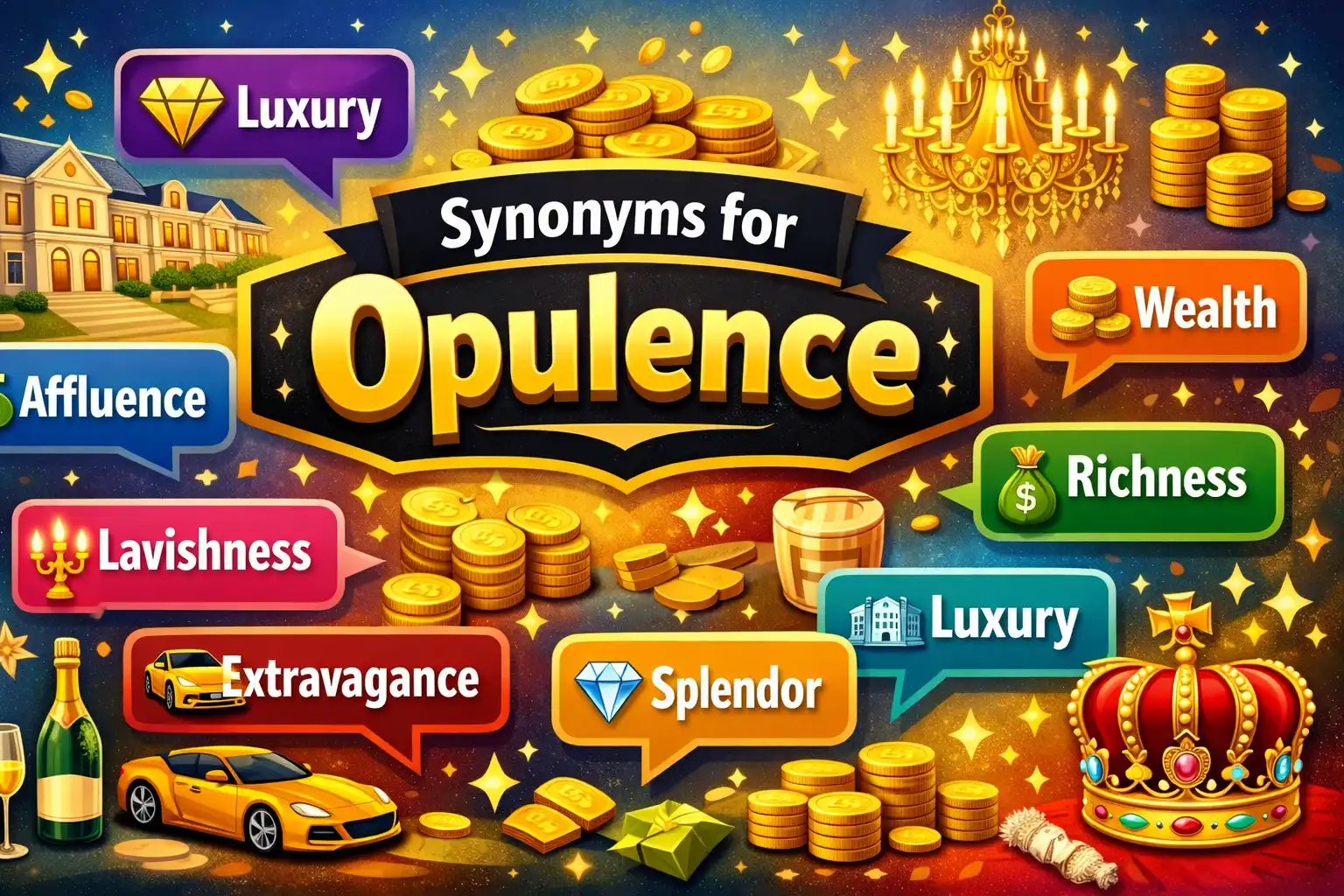
The word opulence appears often in formal writing, luxury branding, history, and descriptive English.
Learning synonyms for opulence helps you avoid repetition and express ideas more clearly.
This guide explains meanings, usage, and alternatives in simple, natural English.
Direct Answer
Synonyms for opulence are words that describe great wealth, richness, or luxurious abundance.
Common synonyms include:
- luxury
- richness
- affluence
- lavishness
- splendor
Meaning of Opulence
Opulence means extreme wealth, richness, or a high level of luxury and abundance.
It often describes places, lifestyles, events, or appearances.
Example:
The palace was filled with opulence, from gold details to rare artwork.
Categories of Synonyms for Opulence (Expanded)
1. Wealth and Abundance
These words focus on financial wealth, resources, and material abundance, not decoration or style.
Words:
- affluence
- prosperity
- wealth
- abundance
- riches
- plenty
Examples:
- The city’s affluence is visible in its private neighborhoods.
- Economic growth brought new prosperity to the region.
- The family’s wealth was built over generations.
- The land produced an abundance of crops.
- The empire was known for its riches.
- There was plenty of food and resources for everyone.
2. Luxury and Refined Comfort
These synonyms emphasize high-quality living, comfort, and refined taste, often without excess.
Words:
- luxury
- elegance
- refinement
- grandeur
- sophistication
- comfort
Examples:
- The hotel offers modern luxury with simple design.
- Her home reflects quiet elegance.
- The interior shows careful refinement.
- The hall has a sense of historic grandeur.
- His style suggests cultural sophistication.
- Guests enjoyed complete comfort during their stay.
3. Visual Richness and Beauty
These words describe how opulence looks, focusing on beauty, detail, and visual impact.
Words:
- splendor
- magnificence
- richness
- brilliance
- radiance
Examples:
- The palace shines with golden splendor.
- The cathedral’s magnificence impressed visitors.
- The fabric’s color adds visual richness.
- The jewels reflected bright brilliance.
- The room had a warm radiance.
4. Lavishness and Excess
These synonyms highlight opulence taken to an extreme, often with a sense of excess or over-display.
Words:
- lavishness
- extravagance
- excess
- indulgence
- profusion
Examples:
- The wedding displayed clear lavishness.
- The party’s extravagance surprised everyone.
- The design crossed into unnecessary excess.
- He lives a life of constant indulgence.
- The garden showed a profusion of rare flowers.
5. Power, Status, and Elite Lifestyle
These words connect opulence to social status, authority, or elite groups.
Words:
- privilege
- prestige
- high society
- elite lifestyle
- influence
Examples:
- Wealth often brings social privilege.
- The brand carries global prestige.
- The event attracted high society guests.
- The magazine showcases an elite lifestyle.
- Financial power gave him political influence.
6. Subtle or Symbolic Opulence
These words describe opulence that is quiet, refined, or symbolic, not loud or flashy.
Words:
- subtle luxury
- understated elegance
- refined wealth
- quiet grandeur
Examples:
- The home shows subtle luxury through materials.
- Her clothing reflects understated elegance.
- The design suggests refined wealth, not excess.
- The space carries quiet grandeur.
Synonyms Table for Opulence (Expanded)
| Word | Simple Meaning | Tone | Example Sentence |
| luxury | very high comfort and quality | Neutral | The hotel offers modern luxury. |
| affluence | having a lot of money | Formal | The suburb is known for its affluence. |
| wealth | large amount of money or assets | Neutral | The family built its wealth over time. |
| riches | valuable money or possessions | Neutral | The kingdom was famous for its riches. |
| abundance | more than enough of something | Neutral | The land provides an abundance of resources. |
| prosperity | success and financial well-being | Formal | Trade brought prosperity to the city. |
| splendor | impressive beauty and richness | Formal | The palace glows with royal splendor. |
| magnificence | great beauty and importance | Formal | Visitors admired the building’s magnificence. |
| grandeur | large-scale beauty and power | Formal | The hall reflects historic grandeur. |
| richness | depth, value, or fullness | Neutral | The décor adds visual richness. |
| elegance | refined beauty and style | Neutral | Her home shows simple elegance. |
| refinement | polished taste and quality | Formal | The design reflects cultural refinement. |
| sophistication | advanced style or taste | Formal | The restaurant shows modern sophistication. |
| lavishness | spending without limits | Neutral | The celebration showed clear lavishness. |
| extravagance | excessive spending or display | Formal | The party’s extravagance shocked guests. |
| indulgence | enjoying luxury freely | Neutral | The spa visit felt like pure indulgence. |
| excess | more than what is needed | Neutral | The décor crossed into excess. |
| profusion | large quantity in rich display | Formal | The garden showed a profusion of flowers. |
| prestige | high respect and status | Formal | The brand carries global prestige. |
| privilege | special advantage or benefit | Neutral | Wealth often brings social privilege. |
Master Synonyms List for Opulence (Grouped by Meaning)
1. Wealth and Financial Abundance
These synonyms describe money, assets, and material wealth, not appearance or decoration.
- Affluence– having a large amount of money
The neighborhood reflects long-term affluence. - Wealth– large financial resources
Her family built its wealththrough business. - Riches– valuable possessions or money
The empire was famous for its natural riches. - Prosperity– financial success and stability
Trade brought lasting prosperity to the region. - Abundance– more than enough resources
The land provides an abundance of food.
2. Luxury and Refined Living
These words focus on comfort, quality, and tasteful living, often without excess.
- Luxury– high comfort and quality
The resort offers modern luxury. - Elegance– refined beauty and style
Her home reflects simple elegance. - Refinement– polished taste and quality
The design shows cultural refinement. - Sophistication– advanced style or taste
The restaurant is known for its sophistication. - Indulgence– enjoying pleasure or comfort
The spa visit felt like pure indulgence.
3. Grandeur and Visual Richness
These synonyms emphasize how opulence looks, especially beauty, scale, and impact.
- Splendor– impressive beauty and richness
The palace shines with golden splendor. - Magnificence– great beauty and importance
Visitors admired the cathedral’s magnificence. - Grandeur– large-scale beauty or power
The hall reflects historic grandeur. - Richness– depth, fullness, or visual value
The fabric adds visual richness. - adiance– glowing beauty or light
The room had a warm radiance.
4. Excess and Over-Display
These words describe opulence taken too far, often with a negative or critical tone.
- Lavishness– spending without limits
The wedding displayed clear lavishness. - Extravagance– excessive luxury or cost
The party’s extravaganceshocked guests. - Excess– more than what is necessary
The décor crossed into unnecessary excess. - rofusion– large quantity in rich display
The garden showed a profusionof flowers.
Formal vs Neutral Synonyms for Opulence
Some synonyms for opulence are best for academic, professional, or literary writing.
Others work better in daily conversation, blogs, and general content.
Below is a clear comparison with real sentence pairs.
Formal Synonyms (Use in Academic or Professional Writing)
These words sound polished, serious, and precise.
Formal words:
- opulence
- affluence
- splendor
- magnificence
- grandeur
- extravagance
Examples:
- The palace reflects royal opulence.
- Economic growth increased national affluence.
- The hall was designed with historical grandeur.
- Visitors admired the building’s magnificence.
- The ceremony displayed cultural splendor.
- The project was criticized for its extravagance.
Neutral (Everyday English) Synonyms
These words are natural, clear, and widely used in speech and informal writing.
Neutral words:
- luxury
- wealth
- richness
- elegance
- comfort
- indulgence
Examples:
- The hotel offers modern luxury.
- The family lives in quiet wealth.
- The room has visual richness.
- Her style shows simple elegance.
- Guests enjoyed total comfort.
- The dessert felt like an indulgence.
Sentence Pairs: Formal vs Neutral Usage
Pair 1
- Formal: The palace symbolizes royal opulence.
- Neutral: The palace shows a lot of luxury.
Pair 2
- Formal: The area is marked by long-term affluence.
- Neutral: The area is very wealthy.
Pair 3
- Formal: The cathedral’s magnificence attracts tourists.
- Neutral: The cathedral is beautiful and impressive.
Pair 4
- Formal: The event was criticized for its extravagance.
- Neutral: The event was too expensive.
Pair 5
- Formal: The interior design reflects subtle grandeur.
- Neutral: The design feels elegant and spacious.
Quick Usage Tip
- Use formal synonyms in essays, reports, branding, and history writing.
- Use neutral synonyms in conversation, blogs, and social content.
- Avoid mixing both styles in the same sentence.
Real-Life Usage Examples
- Conversation: Their home feels very luxurious.
- Academic writing: Opulence reflected social hierarchy.
- Business writing: The brand represents refined luxury.
- Blogging: Subtle opulence defines modern interiors.
- Emotional expression: The room felt rich and warm.
Opulence vs Similar Words(opulence vs wealth vs affluence vs extravagance vs luxury”)
Opulence vs Luxury
- Opulence = extreme, often visual wealth
- Luxury = comfort and high quality
Example:
Luxury focuses on comfort; opulence focuses on abundance.
Opulence vs Lavishness
- Opulence = state or condition
- Lavishness = action or behavior
Example Sentences (Natural Usage)
- The hotel design shows modern opulence.
- Gold details added a sense of richness.
- The banquet reflected royal splendor.
- They admired the lavishness of the décor.
- The mansion represents wealth and luxury.
- Opulence is common in historical palaces.
- The brand avoids loud luxury.
- Subtle opulence feels elegant.
- The hall radiated magnificence.
- Affluence shaped the neighborhood.
- The style suggests refined wealth.
- Opulence can be tasteful or excessive.
Common Mistakes When Using Opulence
- With Wrong → Corrected Sentences)
1. Using opulence for simple comfort or quality
Problem: Opulence is stronger than “comfortable” or “nice.”
❌ Wrong:
The café is known for its opulence and cozy chairs.
✅ Correct:
The café is known for its comfort and cozy chairs.
✅ Correct (if you really mean opulence):
The hotel is known for its opulence, with marble floors and gold details.
2. Using opulence to describe a person directly
Problem: Opulence describes lifestyle, surroundings, or conditions, not personality.
❌ Wrong:
She is an opulence woman.
✅ Correct:
She lives a life of opulence.
✅ Correct:
She is wealthy and lives luxuriously.
3. Replacing luxury with opulence everywhere
Problem: Opulence is not always interchangeable with luxury.
❌ Wrong:
This shampoo offers daily opulence at a low price.
✅ Correct:
This shampoo offers daily luxury at a low price.
✅ Correct (opulence fits better):
The palace reflects centuries of opulence.
4. Using opulence in very casual conversation
Problem: The word sounds formal and heavy in casual speech.
❌ Wrong:
That burger was pure opulence!
✅ Correct:
That burger was luxurious.
✅ Correct (formal context):
The banquet represented royal opulence.
5. Confusing opulence with lavish (noun vs adjective)
Problem: Opulence is a noun; lavish is usually an adjective or verb.
❌ Wrong:
The party was opulence.
✅ Correct:
The party showed great opulence.
✅ Correct:
The party was lavish.
Using opulence for excess without context
Problem: Opulence does not automatically mean “too much.”
❌ Wrong:
The design was bad because of opulence.
✅ Correct:
The design felt excessive and overdone.
✅ Correct (clear criticism):
The design was criticized for its extravagance.
Quick Rule to Remember
Opulence = extreme wealth or richness, usually visible and impressive.
If you only mean nice, comfortable, or expensive, choose a simpler word.
Tips for Choosing the Right Synonym for Opulence
Choosing the right synonym depends on what you want to describe.
Ask yourself what kind of richness you mean.
Mini Decision Guide (Quick Choice)
If you mean money or financial wealth → use:
- wealth
- affluence
- prosperity
Example:
The family’s wealth grew through investments.
If you mean comfort or high-quality living → use:
- luxury
- comfort
- indulgence
Example:
The resort offers quiet luxury by the beach.
If you mean beauty, size, or visual impact → use:
- splendor
- magnificence
- grandeur
Example:
The cathedral’s grandeur impressed visitors.
If you mean expensive decoration or display → use:
- lavishness
- extravagance
- profusion
Example:
The wedding was criticized for its extravagance.
If you mean refined or subtle richness → use:
- elegance
- refinement
- subtle luxury
Example:
Her home reflects elegance, not excess.If you mean status or elite position → use:
- prestige
- privilege
- high society
Example:
The brand carries international prestige.
Additional Best Practices
- Choose formal words for essays, reports, and history writing.
- Choose neutral words for conversation and blogs.
- Avoid using opulence when you only mean comfortable or nice.
- Do not mix formal and casual words in the same sentence.
- Use one strong word, not multiple synonyms together.
Simple Rule to Remember
If the meaning is not extreme or impressive, opulence is probably too strong.
When NOT to Use Opulence
Use opulence only when the idea involves extreme, visible richness or abundance.
Avoid it in the situations below.
1. When the situation is ordinary or everyday
Opulence sounds unnatural for normal daily experiences.
Avoid:
- food
- casual places
- daily products
Better choices:
comfort, quality, nice, enjoyable
Example:
❌ The café offers opulence at breakfast.
✅ The café offers quality breakfast.
2. When describing simple luxury or comfort
Not all luxury is opulence.
Opulence is much stronger.
Avoid when you mean:
- clean
- modern
- premium
- comfortable
Better choices:
luxury, elegance, refinement
Example:
❌ The apartment feels opulent and cozy.
✅ The apartment feels luxurious and cozy.
3. When writing informal or conversational content
The word sounds too heavy in casual speech.
Avoid in:
- texting
- social media captions
- casual conversation
Better choices:
luxurious, fancy, high-end
Example:
❌ That jacket is opulence.
✅ That jacket looks high-end.
4. When describing people directly
Opulence does not describe personality or character.
Avoid:
- “opulent man” (for personality)
- “opulent woman”
Correct usage:
Describe lifestyle, surroundings, or possessions.
Example:
❌ She is opulent.
✅ She lives a life of opulence.
5. When criticizing something as “too much”
Opulence is neutral, not automatically negative.
Avoid if you mean:
- wasteful
- overdone
- excessive
Better choices:
extravagance, excess, overindulgence
Example:
❌ The design failed due to opulence.
✅ The design failed due to extravagance.
6. When precision matters more than style
In technical, business, or factual writing, opulence can be vague.
Avoid when clarity is required.
Use direct terms like wealth, spending, or cost.
Example:
❌ The company’s opulence increased.
✅ The company’s spending increased.
One-Line Rule to Remember
Use opulence only when richness is extreme, visible, and impressive — not just expensive or comfortable.
Opposite Words (Antonyms)
- simplicity
- modesty
- poverty
- plainness
- restraint
FAQs
What is the closest meaning to opulence?
Extreme wealth combined with luxury and abundance.
Does opulent mean lavish?
Yes, but opulent describes a state, while lavish often describes actions.
Can you call a person opulent?
Yes, but it usually describes lifestyle, not personality.
What is the root word of opulence?
It comes from Latin opulentus, meaning wealthy or powerful.
How to say luxury without saying luxury?
You can use richness, elegance, affluence, or refinement.
Conclusion
Learning synonyms for opulence improves writing clarity and expression.
It helps you choose the right tone for essays, blogs, and professional content.
Try using three new synonyms in your next paragraph.

Andrew Powell is a research-focused editorial writer specializing in word meanings, semantic distinctions, and language accuracy. With a professional background in research-based informational writing, he has built his work around careful analysis of how words function in context and how subtle variations in meaning influence communication.
Andrew’s expertise lies in word comparison and semantic precision. His work examines closely related terms, clarifies usage differences, and explains how context shapes interpretation. Rather than offering surface-level definitions, he approaches language with a structured methodology—reviewing usage patterns, consulting authoritative dictionaries, analyzing corpus data, and evaluating real-world examples. This research-driven process ensures that readers receive clear, reliable explanations grounded in linguistic evidence.
A core focus of his writing is helping readers understand meaning differences that are often overlooked. Whether distinguishing between near-synonyms, exploring formal versus informal usage, or clarifying nuanced grammatical structures, Andrew aims to remove ambiguity. His explanations are designed to support students, writers, educators, and professionals who rely on precise language in academic, business, or creative contexts.
Andrew contributes to the Word Synonyms niche with an emphasis on clarity, neutrality, and factual accuracy. He prioritizes language accuracy over simplification and avoids unsupported claims. Each piece is structured to answer specific user queries while maintaining contextual depth, aligning with current search quality standards and semantic SEO principles.
By combining research-based writing with careful editorial standards, Andrew Powell helps readers develop stronger vocabulary awareness and make informed word choices. His work reflects a commitment to trustworthy information, thoughtful analysis, and practical value for anyone seeking a deeper understanding of English semantics.