The word enterprise is common in business, school writing, and news reports.
It usually relates to companies, projects, or bold ideas.
Learning synonyms for enterprise helps you speak and write more clearly.
Direct Answer
Enterprise means a business, project, or bold plan that requires effort and risk.
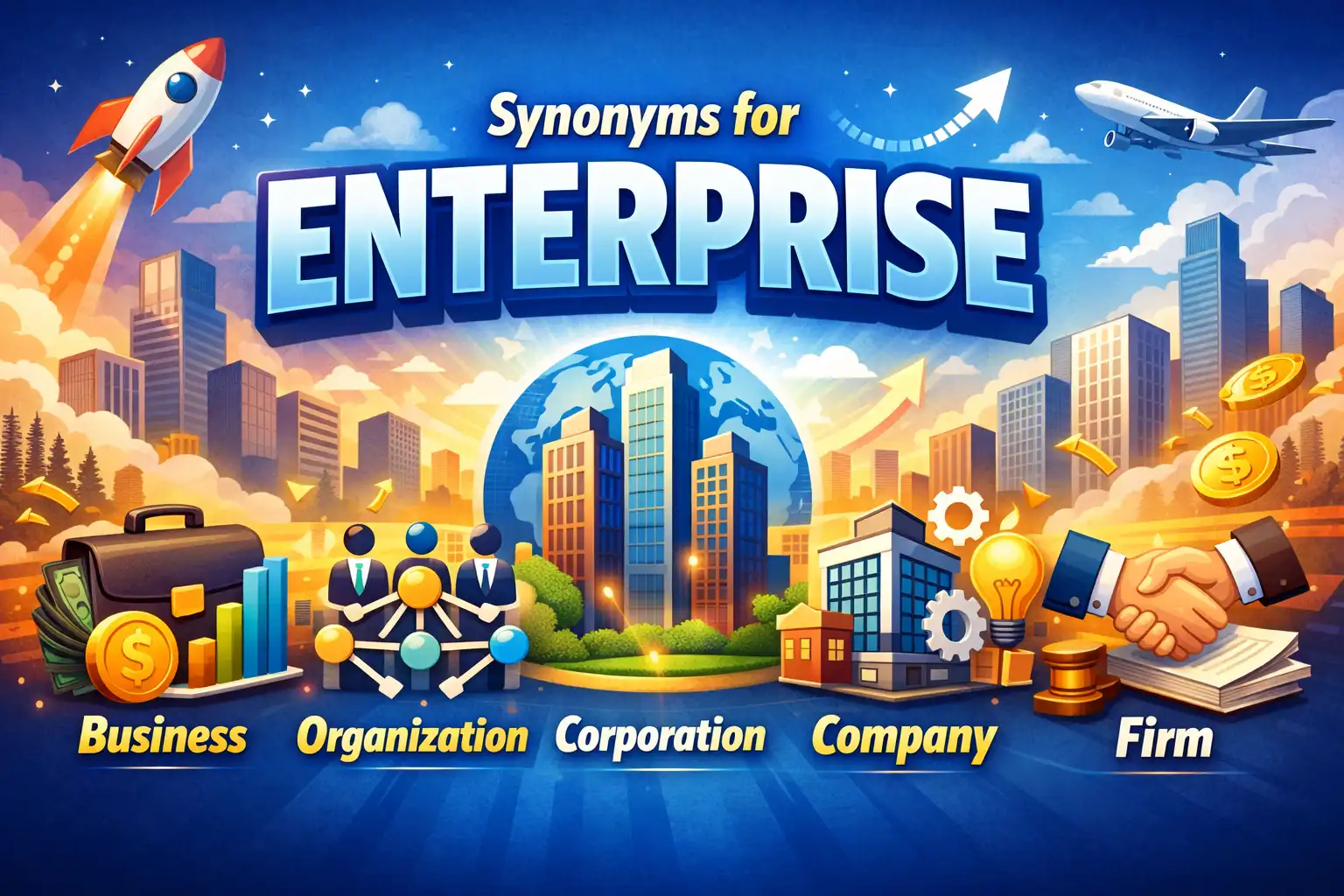
Common synonyms include:
- Business
- Company
- Firm
- Venture
- Startup
- Corporation
- Organization
- Undertaking
- Initiative
- Operation
Meaning of Enterprise
Enterprise refers to a business activity, company, or ambitious project that involves effort, planning, and sometimes risk.
Example:
She started a small enterprise selling handmade candles.
Categories of Synonyms
1. Business or Company Meaning
These words refer to a commercial organization that sells products or services.
2. Project or Plan Meaning
These words describe a task or activity that requires effort and planning.
3. Bold or Risky Activity Meaning
These words emphasize risk, innovation, or ambition.
Synonyms Table
| Word | Simple Meaning | Example Sentence |
| Business | Company that sells goods or services | He runs a small business from home. |
| Company | Organized group for work | The company hired new staff. |
| Firm | Business organization | The law firm opened a new office. |
| Venture | Risky business project | They launched a tech venture. |
| Startup | New business | The startup raised funding. |
| Corporation | Large legal company | The corporation operates worldwide. |
| Organization | Structured group | The organization supports local farmers. |
| Undertaking | Serious project | Building the bridge was a huge undertaking. |
| Initiative | New plan or action | The school started a recycling initiative. |
| Operation | Business activity | The factory runs a 24-hour operation. |
Master Synonyms List (Grouped by Level)
Beginner / Simple
Business
Simple meaning: Company that makes money
Example: She owns a business in New York.
(Formal & Informal)
Company
Simple meaning: Organized group for work
Example: The company launched a new product.
(Neutral)
Startup
Simple meaning: New small business
Example: His startup develops mobile apps.
(Informal/Modern)
Intermediate
Firm
Simple meaning: Professional business
Example: The firm hired three accountants.
(Formal)
Venture
Simple meaning: Risky project
Example: Their venture failed after one year.
(Neutral)
Organization
Simple meaning: Structured group
Example: The organization provides medical aid.
(Formal)
Operation
Simple meaning: Business activity
Example: The mining operation employs 200 workers.
(Formal)
Advanced / Formal
Corporation
Simple meaning: Large registered company
Example: The corporation expanded internationally.
(Formal)
Undertaking
Simple meaning: Major project
Example: Building the airport was a massive undertaking.
(Formal)
Initiative
Simple meaning: Planned action
Example: The climate initiative gained support.
(Formal)
Formal vs Informal Synonyms
Use corporation, undertaking, and initiative in academic or professional writing.
Use business, company, or startup in daily conversation.
Choose the synonym based on audience and context.
Real-Life Usage Examples
Conversation
“I want to start a small business next year.”
Academic Writing
“The enterprise contributed to regional economic growth.”
Business Writing
“Our company plans to expand operations.”
Blogging
“This startup changed the online shopping industry.”
Emotional Expression
“Launching this venture was my biggest dream.”
Similar Words Comparison
Enterprise vs Business
Enterprise often sounds more formal or ambitious.
Business is more common in daily speech.
Example:
He owns a small business.
She built a successful enterprise.
Enterprise vs Venture
Enterprise can describe a company or activity.
Venture focuses more on risk.
Example:
The enterprise employs 50 people.
The venture involved financial risk.
Example Sentences
- The enterprise created new jobs in the town.
- She invested in a local company.
- Their venture attracted investors.
- The firm specializes in marketing.
- The organization helps refugees.
- The startup developed a new app.
- His business grew quickly.
- The corporation reported high profits.
- The initiative improved public safety.
- The undertaking required careful planning.
- The operation runs smoothly.
- This enterprise supports local farmers.
- They expanded the company overseas.
- The venture was successful.
- She manages a family business.
Common Mistakes
1. Using “enterprise” for very small actions
Do not say “cleaning my room was an enterprise.”
It is too formal for small tasks.
2. Confusing “venture” with “adventure”
A venture is business-related.
An adventure is for travel or fun.
3. Using “corporation” for small shops
Corporation usually refers to large companies.
4. Repeating the same word
Avoid using enterprise many times in one paragraph.
Tips for Choosing the Right Synonym
- Think about tone. Is it formal or casual?
- Consider context. Is it a business or a project?
- Match the level of risk or ambition.
- Avoid overuse. Use variety naturally.
- Do not force advanced words into simple writing.
When NOT to Use Enterprise
Do not use enterprise for:
- Small daily tasks
- Personal hobbies
- Informal chats about simple activities
It sounds too formal in these cases.
Opposite Words (Antonyms)
Antonyms of enterprise depend on meaning. Some opposites describe results. Others describe business events.
Conceptual Opposites (Idea or Outcome)
These focus on results or lack of effort:
- Failure – Lack of success
- Inactivity – No action taken
- Laziness – Lack of effort
- Passivity – No initiative or drive
- Success – Positive result (opposite of a failed enterprise)
- Achievement – Completed goal (opposite of an unsuccessful enterprise)
Note: Success and achievement are conceptual opposites when enterprise refers to a risky effort that may fail.
Business-Event Opposites
These refer to ending or stopping a business:
- Closure – Official closing of a business
- Shutdown – Temporary or permanent stop of operations
- Liquidation – Selling assets to close a company
- Bankruptcy – Legal state of financial failure
Note: Closure and shutdown are event-based opposites. They describe what happens when an enterprise stops operating.
Understanding the type of opposite helps you choose the correct word for your sentence.
FAQs
What does enterprise mean?
It means a business, project, or bold activity that requires effort and planning.
Is enterprise formal or informal?
It is slightly formal and often used in business or academic contexts.
How can I use it in conversation?
You can say, “She runs a small enterprise.”
What is the best synonym for enterprise?
Business is the most common and simple synonym.
Can enterprise be replaced with company?
Yes, in many business contexts it can.
Conclusion
Learning synonyms for enterprise improves your vocabulary and writing skills.
It helps you sound clear, professional, and natural.
Try using 3 new synonyms in your next sentence.

Andrew Powell is a research-focused editorial writer specializing in word meanings, semantic distinctions, and language accuracy. With a professional background in research-based informational writing, he has built his work around careful analysis of how words function in context and how subtle variations in meaning influence communication.
Andrew’s expertise lies in word comparison and semantic precision. His work examines closely related terms, clarifies usage differences, and explains how context shapes interpretation. Rather than offering surface-level definitions, he approaches language with a structured methodology—reviewing usage patterns, consulting authoritative dictionaries, analyzing corpus data, and evaluating real-world examples. This research-driven process ensures that readers receive clear, reliable explanations grounded in linguistic evidence.
A core focus of his writing is helping readers understand meaning differences that are often overlooked. Whether distinguishing between near-synonyms, exploring formal versus informal usage, or clarifying nuanced grammatical structures, Andrew aims to remove ambiguity. His explanations are designed to support students, writers, educators, and professionals who rely on precise language in academic, business, or creative contexts.
Andrew contributes to the Word Synonyms niche with an emphasis on clarity, neutrality, and factual accuracy. He prioritizes language accuracy over simplification and avoids unsupported claims. Each piece is structured to answer specific user queries while maintaining contextual depth, aligning with current search quality standards and semantic SEO principles.
By combining research-based writing with careful editorial standards, Andrew Powell helps readers develop stronger vocabulary awareness and make informed word choices. His work reflects a commitment to trustworthy information, thoughtful analysis, and practical value for anyone seeking a deeper understanding of English semantics.