The word construct is common in daily speech, academic writing, and business communication.
It usually means to build or create something.
Learning synonyms for construct helps you write clearly and avoid repeating the same word.
Construct Meaning (Quick Definition) + Top Synonyms
Construct means to build, create, or form something by putting parts together.
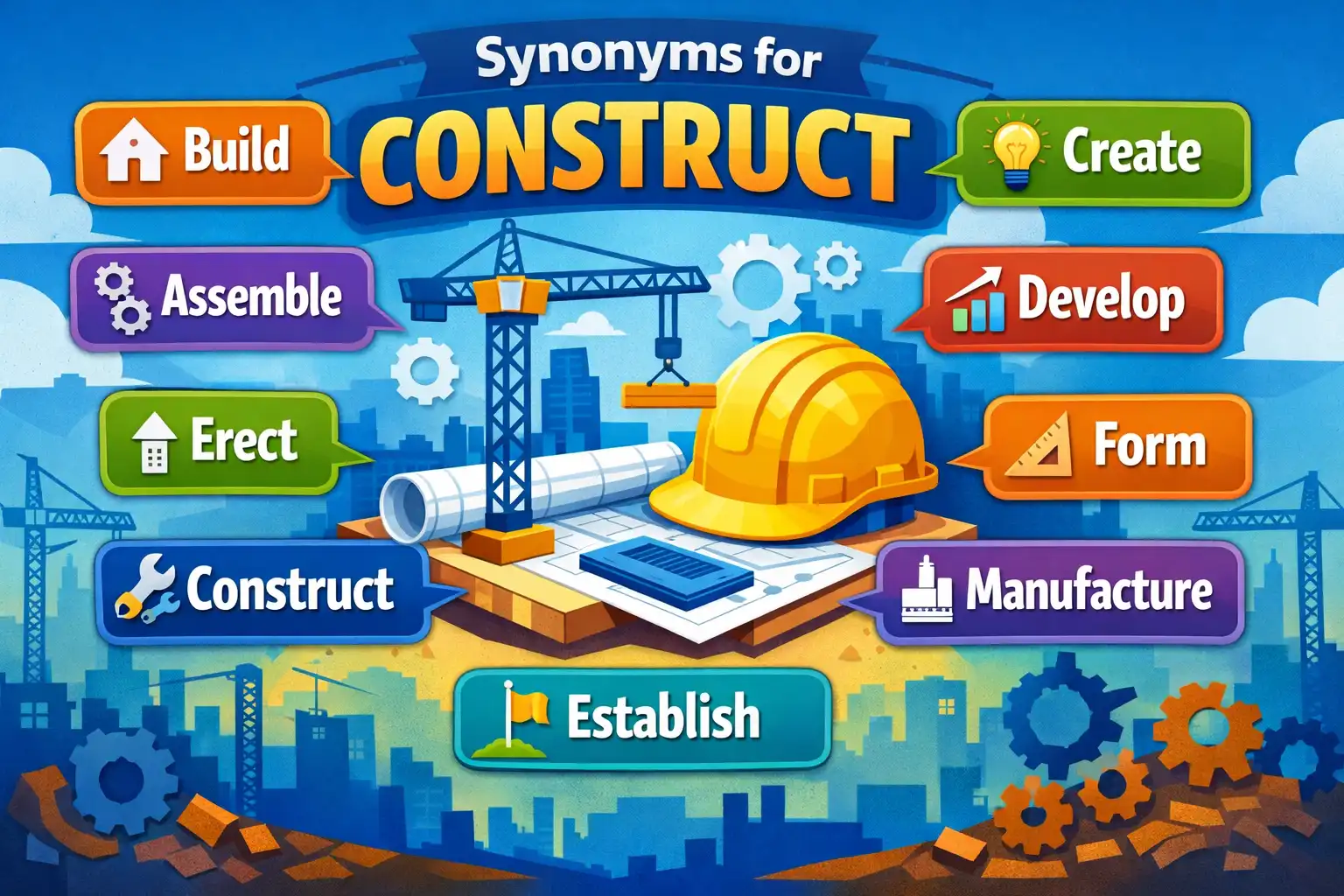
Common synonyms for construct:
- Build
- Create
- Develop
- Form
- Establish
- Assemble
- Produce
- Erect
- Compose
- Fabricate
Meaning of Construct (Verb) + Example
Construct means to build or make something by putting parts together in an organized way.
It can refer to physical objects or ideas.
Example:
The company plans to construct a new office building next year.
Synonyms for Construct by Context (Physical vs Abstract vs Formal)
1. Physical Building
These words describe building something real, such as a house or bridge.
Examples: build, erect, assemble
2. Creating Ideas or Plans
These words describe forming something abstract like a theory or strategy.
Examples: create, develop, compose
3. Organized Production
These words describe making something carefully or formally.
Examples: fabricate, produce, establish
Synonyms for Construct (Table + Examples)
| Word | Simple Meaning | Example Sentence |
| Build | Make something physical | They plan to build a house. |
| Create | Make something new | She will create a new design. |
| Develop | Improve or grow step by step | The team developed a new system. |
| Form | Bring into shape | They formed a committee. |
| Establish | Set up officially | The school established new rules. |
| Assemble | Put parts together | He assembled the furniture. |
| Produce | Make or manufacture | The factory produces cars. |
| Erect | Build upright | Workers erected a fence. |
| Compose | Put together carefully | She composed a report. |
| Fabricate | Make or invent | The company fabricated metal parts. |
Construct Synonyms by Tone (Simple, Neutral, Formal)
Beginner / Simple
Build
Simple meaning: make something physical
Example: They will build a new park.
Make
Simple meaning: create something
Example: She wants to make a website.
Create
Simple meaning: bring something new into existence
Example: The artist created a beautiful painting.
Intermediate
Develop
Simple meaning: grow or create step by step
Example: The company developed a new app.
Form
Simple meaning: organize or shape
Example: They formed a study group.
Assemble
Simple meaning: put parts together
Example: He assembled the desk himself.
Produce
Simple meaning: manufacture or make
Example: The factory produces electric cars.
Advanced / Formal
Establish (Formal)
Simple meaning: set up officially
Example: The university established a research center.
Erect (Formal)
Simple meaning: build upright
Example: Workers erected a monument in the city.
Compose (Formal)
Simple meaning: create by arranging parts
Example: She composed a detailed proposal.
Fabricate (Formal)
Simple meaning: manufacture or invent
Example: The company fabricated steel structures.
Formal vs Informal Synonyms
- Use build or make in everyday conversation.
- Use develop or create in school writing.
- Use establish, erect, or fabricate in formal or business contexts.
Choosing the correct level makes your message sound natural.
Real-Life Usage Examples
Conversation:
We plan to build a new garage this summer.
Academic Writing:
Researchers developed a new theoretical model.
Business Writing:
The company established offices in three countries.
Blogging:
This guide will help you create better content.
Emotional Expression:
She worked hard to build confidence.
Similar Words Comparison
Construct vs Build
Both mean to make something physical.
Construct is more formal.
Build is common in daily speech.
Example:
The city will construct a bridge. (formal)
They will build a bridge. (everyday)
Construct vs Create
Construct often focuses on structure and organization.
Create is broader and can be artistic or abstract.
Example:
Engineers constructed the framework.
The designer created a new logo.
Example Sentences
- Engineers completed the highway overpass ahead of schedule.
- She built a small business from her kitchen.
- The design team created a modern brand identity.
- Scientists developed a safer vaccine formula.
- The board established new hiring standards.
- He assembled the bookshelf without instructions.
- This company produces eco-friendly packaging.
- Workers erected temporary shelters after the storm.
- The author composed a powerful opening paragraph.
- The manufacturer fabricated parts for aircraft engines.
- Several startups formed a technology alliance.
- Architects designed and constructed a sustainable home.
- The teacher created an engaging lesson plan.
- The software team developed an advanced security feature.
Common Mistakes
- Using construct in casual speech
It may sound too formal. Use build instead. - Confusing fabricate with create
Fabricate can sometimes mean invent falsely. - Using erect in everyday situations
It sounds formal and is mostly used for buildings or monuments. - Repeating build too often
Use alternatives to improve writing quality.
Tips / Best Practices
- Choose the synonym based on tone.
- Check if the context is physical or abstract.
- Use formal words in academic or business writing.
- Avoid repeating the same word too many times.
- Focus on clarity, not complexity.
When NOT to Use Construct
Do not use construct for very simple daily actions.
Incorrect:
I constructed a sandwich.
Better:
I made a sandwich.
Also avoid using it when talking about emotions in casual speech.
- Here is an improved Opposite Words (Antonyms) section with short, clear definitions in a mini-table format:
- Opposite Words (Antonyms)
| Word | Simple Meaning |
| Destroy | Damage completely so it cannot be used |
| Demolish | Tear down a building or structure |
| Dismantle | Take something apart piece by piece |
| Break | Separate into parts by force |
| Ruin | Damage something badly |
- These words describe actions that remove, damage, or take apart something instead of building or creating it.
FAQs
What does construct mean?
It means to build or create something by putting parts together.
Is construct formal or informal?
It is more formal than “build.”
How can I use it in conversation?
You can use it when talking about projects or buildings.
What is the best synonym for construct?
“Build” is the most common and simple synonym.
Can construct be replaced with create?
Yes, in many cases, especially when talking about ideas.
Conclusion
Learning synonyms for construct helps you speak and write more clearly.
It improves vocabulary variety and communication skills.
Try using 3 new synonyms in your next sentence.
Quick Recap
- Construct means to build or create something in an organized way.
- Use build for daily conversation.
- Use develop or create for ideas and projects.
- Use establish or erect in formal writing.
- Choose the synonym based on tone and context.
If you want to expand your vocabulary even more, read our guide on synonyms for create to compare similar words and improve your writing precision.

Andrew Powell is a research-focused editorial writer specializing in word meanings, semantic distinctions, and language accuracy. With a professional background in research-based informational writing, he has built his work around careful analysis of how words function in context and how subtle variations in meaning influence communication.
Andrew’s expertise lies in word comparison and semantic precision. His work examines closely related terms, clarifies usage differences, and explains how context shapes interpretation. Rather than offering surface-level definitions, he approaches language with a structured methodology—reviewing usage patterns, consulting authoritative dictionaries, analyzing corpus data, and evaluating real-world examples. This research-driven process ensures that readers receive clear, reliable explanations grounded in linguistic evidence.
A core focus of his writing is helping readers understand meaning differences that are often overlooked. Whether distinguishing between near-synonyms, exploring formal versus informal usage, or clarifying nuanced grammatical structures, Andrew aims to remove ambiguity. His explanations are designed to support students, writers, educators, and professionals who rely on precise language in academic, business, or creative contexts.
Andrew contributes to the Word Synonyms niche with an emphasis on clarity, neutrality, and factual accuracy. He prioritizes language accuracy over simplification and avoids unsupported claims. Each piece is structured to answer specific user queries while maintaining contextual depth, aligning with current search quality standards and semantic SEO principles.
By combining research-based writing with careful editorial standards, Andrew Powell helps readers develop stronger vocabulary awareness and make informed word choices. His work reflects a commitment to trustworthy information, thoughtful analysis, and practical value for anyone seeking a deeper understanding of English semantics.