Micro Introduction
The word brilliance is common in daily speech, writing, education, and creative fields.
It can describe intelligence, beauty, or brightness.
Learning synonyms for brilliance helps you express ideas clearly and avoid repetition.
Direct Answer
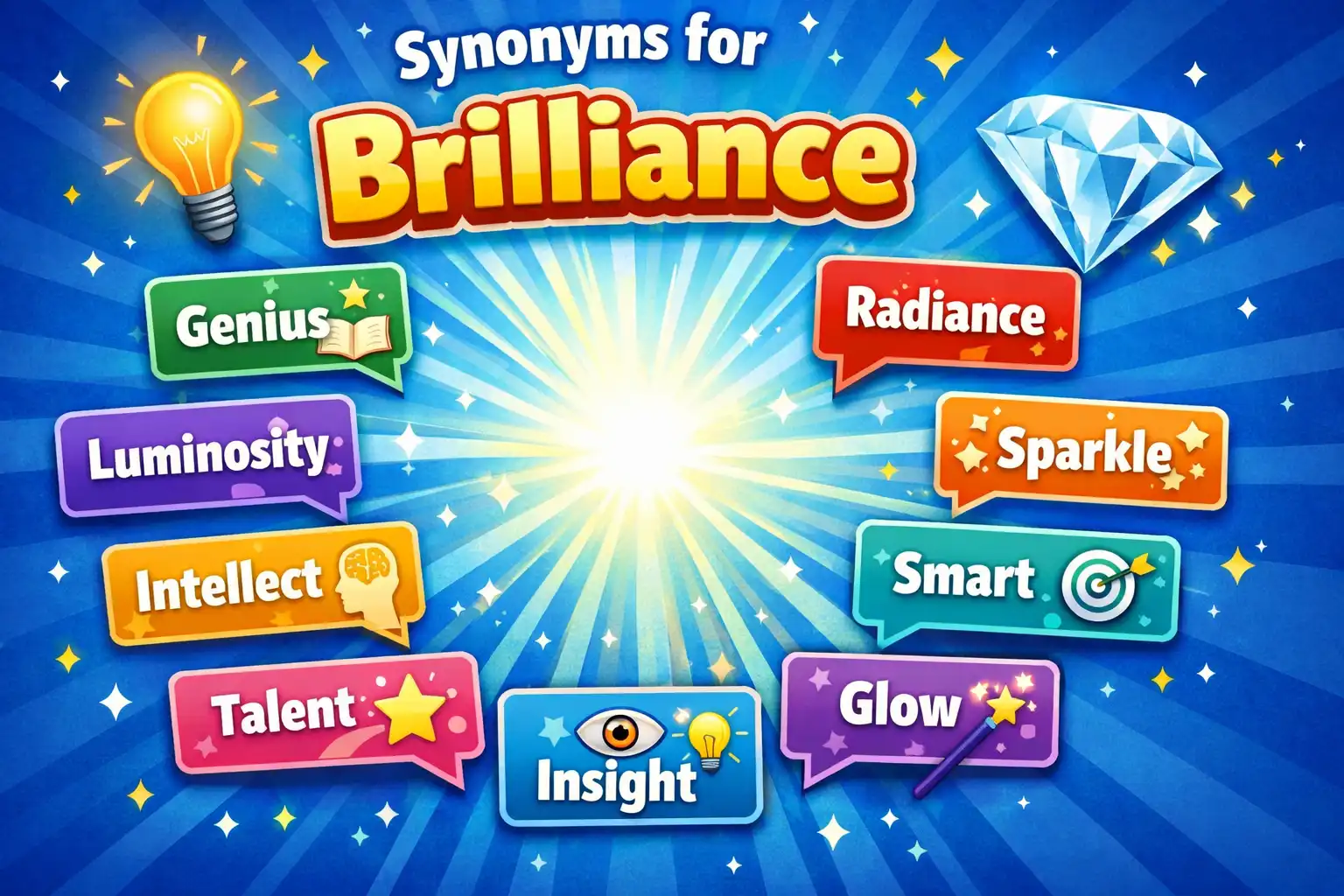
Synonyms for brilliance include words that describe intelligence, beauty, or brightness.
Common synonyms:
- Intelligence
- Genius
- Radiance
- Excellence
- Sparkle
Meaning of Brilliance
Brilliance means exceptional intelligence, great skill, or striking brightness or beauty.
Example:
Her scientific discovery showed real brilliance.
Categories of Synonyms for Brilliance (More Practical + Engaging)
1) Brilliance as “High Intelligence” (People, ideas, solutions)
Use these when you mean smart thinking, problem-solving, or talent in the mind.
Best synonyms: intelligence, genius, sharpness
Practical examples:
- “Her intelligence made the report easy to understand.”
- “That shortcut was pure genius.”
- “He answered with sharpness and confidence.”
2) Brilliance as “Bright Light / Shine” (Objects, places, visuals)
Use these when you mean strong light, glow, or something that looks bright.
Best synonyms: radiance, sparkle, luminosity, brightness
Practical examples:
- “The sunset filled the sky with radiance.”
- “The diamond has a natural sparkle.”
- “Increase the photo’s luminosity slightly.” (photo editing)
- “The room’s brightness makes it feel bigger.”
3) Brilliance as “Outstanding Quality” (Work, results, performance)
Use these when you mean excellent standards or high-level results.
Best synonyms: excellence, distinction, mastery
Practical examples:
- “Their service is known for excellence.”
- “She graduated with distinction.”
- “His mastery of the topic is clear.”
Quick “Choose the Right Category” Tip
- Talking about a person’s mind or idea → intelligence / genius / sharpness
- Talking about light, shine, photo look → radiance / sparkle / luminosity
- Talking about quality of work or achievement → excellence / distinction / mastery
Synonyms Table
| Word | Simple Meaning | Example Sentence |
| Intelligence | Ability to think well | His intelligence impressed the team. |
| Genius | Very high intelligence | She is a mathematical genius. |
| Radiance | Bright beauty or light | The sunset had a warm radiance. |
| Excellence | Very high quality | The school is known for excellence. |
| Sparkle | Small bright shine | Her eyes had a natural sparkle. |
Master Synonyms List (Grouped by Level)
Beginner / Simple
Intelligence – ability to understand and learn
→ Her intelligence helps her solve problems quickly.
Brightness – strong light or clarity
→ The room was filled with brightness.
Beauty – pleasing appearance
→ The painting shows natural beauty.
Intermediate
Genius (formal) – extremely high intelligence
→ His genius changed modern technology.
Radiance (neutral) – soft shining beauty
→ The bride’s radiance was clear.
Excellence (formal) – very high standard
→ The company aims for excellence.
Advanced / Formal
Distinction (formal) – special quality or honor
→ She graduated with distinction.
Luminosity (formal, technical) – light brightness
→ Adjust the image luminosity carefully.
Brilliance (neutral) – combined intelligence or beauty
→ The speech showed true brilliance.
Formal vs Informal Synonyms
- Formal: brilliance, excellence, distinction, genius
Used in academic, business, or professional writing. - Informal: sparkle, brightness, sharpness
Used in conversation, blogs, or casual speech.
Choose based on audience and purpose.
Real-Life Usage Examples
Conversation:
“She solved it fast. That’s real brilliance.”
Academic Writing:
“The theory demonstrates intellectual brilliance.”
Business Writing:
“Her leadership reflects strategic brilliance.”
Blogging:
“This photo editing trick adds brilliance to images.”
Emotional Expression:
“I admire his creative brilliance.”
Similar Words Comparison
Brilliance vs Genius
- Brilliance can describe moments or results.
- Genius describes a person’s overall intelligence.
Example:
The idea showed brilliance, but he is not called a genius yet.
Brilliance vs Radiance
- Brilliance can be mental or visual.
- Radiance is mainly visual or emotional beauty.
Example Sentences
- Her brilliance impressed everyone.
- The student’s intelligence stood out.
- The diamond had strong radiance.
- His work shows creative excellence.
- There was a sparkle in her smile.
- The professor is known for genius ideas.
- Photo filters increase image luminosity.
- Her speech reflected mental sharpness.
- The team achieved distinction in research.
- His calm answers showed clear brilliance.
- The artwork glowed with soft radiance.
- Intelligence without effort is rare brilliance.
- Her writing combines clarity and excellence.
- That solution required real genius.
Common Mistakes
- Using brilliance only for intelligence (it also means beauty).
- Replacing brilliance with genius when talking about objects.
- Overusing advanced words in casual speech.
- Mixing formal synonyms in informal conversation.
Tips for Choosing the Right Synonym
- Match the context (mental vs visual).
- Check the formality level.
- Keep sentences clear and natural.
- Avoid repeating the same word too often.
When NOT to Use Brilliance
- Do not use it for basic skills.
- Avoid it in very casual speech if it sounds unnatural.
- Do not replace it with emotional words like happiness.
Opposite Words (Antonyms)
- Dullness
- Mediocrity
- Darkness
- Weakness
- Ignorance
FAQs – People Also Ask
What are the synonyms of brilliance?
Common synonyms include intelligence, genius, radiance, excellence, and sparkle.
What is a synonym for smart brilliant?
Words like intelligence, genius, and sharpness work well.
What is brilliance also known as?
It can mean intelligence, brightness, or outstanding quality.
What does brilliance mean?
It means exceptional intelligence, beauty, or brightness.
Is brilliance formal or informal?
It is neutral and works in both formal and informal English.
Conclusion
Learning synonyms for brilliance improves writing clarity and speaking confidence.
It helps you choose precise words for intelligence, beauty, or excellence.
Try using three new synonyms in your next sentence.

Andrew Powell is a research-focused editorial writer specializing in word meanings, semantic distinctions, and language accuracy. With a professional background in research-based informational writing, he has built his work around careful analysis of how words function in context and how subtle variations in meaning influence communication.
Andrew’s expertise lies in word comparison and semantic precision. His work examines closely related terms, clarifies usage differences, and explains how context shapes interpretation. Rather than offering surface-level definitions, he approaches language with a structured methodology—reviewing usage patterns, consulting authoritative dictionaries, analyzing corpus data, and evaluating real-world examples. This research-driven process ensures that readers receive clear, reliable explanations grounded in linguistic evidence.
A core focus of his writing is helping readers understand meaning differences that are often overlooked. Whether distinguishing between near-synonyms, exploring formal versus informal usage, or clarifying nuanced grammatical structures, Andrew aims to remove ambiguity. His explanations are designed to support students, writers, educators, and professionals who rely on precise language in academic, business, or creative contexts.
Andrew contributes to the Word Synonyms niche with an emphasis on clarity, neutrality, and factual accuracy. He prioritizes language accuracy over simplification and avoids unsupported claims. Each piece is structured to answer specific user queries while maintaining contextual depth, aligning with current search quality standards and semantic SEO principles.
By combining research-based writing with careful editorial standards, Andrew Powell helps readers develop stronger vocabulary awareness and make informed word choices. His work reflects a commitment to trustworthy information, thoughtful analysis, and practical value for anyone seeking a deeper understanding of English semantics.